
Knowledge of water softening equipment
Category:
Time of issue:2021-03-06

In daily life, we often see scale forming on the inner walls of kettles after prolonged use. What is the reason for this? It turns out that the water we use contains many inorganic salts, such as calcium and magnesium salts. These salts are invisible to the naked eye in water at room temperature. Once they are heated and boiled, many calcium and magnesium salts precipitate out as carbonates, adhering to the kettle walls to form scale. We usually use the indicator "hardness" to represent the content of calcium and magnesium ions in water. A hardness of 1 degree is equivalent to 10 mg of calcium oxide per liter of water. Water below 8 degrees is called soft water, above 17 degrees is called hard water, and between 8 and 17 degrees is called moderately hard water. Rainwater, snow water, river water, lake water are all soft water, while spring water, deep well water, and seawater are all hard water.
Difference between softened water and other water
Raw water refers to untreated water. In a broad sense, water entering the water treatment process is also called raw water for that water treatment. For example, water delivered from the water source to the clarifier is called raw water.
Softened water refers to water with reduced hardness (mainly refers to the removal or reduction of calcium and magnesium ions in water) to a certain extent. During the softening process, only the hardness is reduced, while the total salt content remains unchanged.
Desalinated water refers to water with reduced salts (mainly strong electrolytes dissolved in water) removed or reduced to a certain extent. Its conductivity is generally 1.0~10.0μS/cm, resistivity (25℃)(0.1~1.0)×106Ω˙cm, and salt content is 1~5mg/L.
Pure water refers to water with reduced strong and weak electrolytes (such as SiO2, CO2, etc.). Its conductivity is generally 1.0~0.1μS/cm, resistivity (1.01.0~10.0)×106Ω˙cm. Salt content is <1mg/L.
Ultrapure water refers to water in which conductive media are almost completely removed, and non-dissociated gases, colloids, and organic substances (including bacteria, etc.) are also removed to a very low level. Its conductivity is generally 0.1~0.055μS/cm, resistivity (25℃)﹥10×106Ω˙cm, and salt content ﹤0.1mg/L. Ideal pure water (theoretically) has a conductivity of 0.05μS/cm and a resistivity (25℃) of 18.3×10⁶Ω˙cm.
What is water softening treatment? ?
Using strongly acidic cation resin to replace the calcium and magnesium ions in the raw water, and then filtering the softened water through the equipment to obtain boiler feed water with extremely low hardness.
Working principle
Ion exchange method
Method: Using specific cation exchange resin to replace calcium and magnesium ions in water with sodium ions. Due to the high solubility of sodium salts, it avoids the formation of scale with increasing temperature.
Features and effects: Stable and accurate effect, mature technology. Hardness can be reduced to 0.
Application range: Catering, food, chemical, pharmaceutical industries, air conditioning, industrial circulating water, etc. Currently the most commonly used standard method.
Electromagnetic method
Method: Applying a certain electric field or magnetic field in water to change the characteristics of ions, thereby changing the deposition rate and physical properties of calcium carbonate (magnesium carbonate) to prevent the formation of hard scale.
Features and effects: Low equipment investment, easy installation, low operating cost. The effect is not stable enough, there is no unified measurement standard, and because the main function is only to affect the physical properties of scale within a certain range, the use time and distance of the treated water are limited.
Application range: Mostly used in commercial (such as central air conditioning) circulating cooling water treatment, not applicable to industrial production and boiler feed water treatment.
Membrane separation method
Method: Nanofiltration membrane (NF) and reverse osmosis membrane (RO) can intercept calcium and magnesium ions in water, thus fundamentally reducing water hardness.
Hardness can only be reduced to a certain range.
Features and effects: The effect is obvious and stable, and the treated water has a wide range of applications. It has high requirements for inlet pressure, and the equipment investment and operating cost are high.
Application range: Generally less used for special softening treatment.
Lime method
Method: Adding lime to water.
Features and effects: Hardness can only be reduced to a certain range.
Application range: Applicable to large-flow high-hardness water.
Chemical addition method
Method: Adding special scale inhibitors to water can change the characteristics of calcium and magnesium ions combining with carbonate ions, so that scale cannot precipitate and deposit.
Features and effects: Low one-time investment, wide adaptability. Operating cost is high when water volume is large.
Application range: Due to the addition of chemicals, the application of water is greatly limited, and generally it cannot be used for drinking, food processing, industrial production, etc. It is also rarely used in civil applications.
Working process and requirements of water softening equipment
1) Working process of water softening equipment
Work The process involves five steps: backwashing, salting (regeneration), slow rinsing (displacement), and fast rinsing. Different water softening equipment has very similar processes, with only minor additional steps due to differences in actual processes or control needs. Any water softening equipment based on sodium ion exchange is developed based on these five processes (among them, fully automatic water softening equipment will add a brine recharge process).
Backwashing: After operating for a period of time, the equipment will intercept many impurities from the raw water at the top of the resin. After removing these impurities, the ion exchange resin can be fully exposed, and the regeneration effect can be guaranteed. The backwashing process is the process of washing water from the bottom of the resin and flowing out from the top, which can flush away the impurities intercepted at the top. This process generally takes about 5-15 minutes. Salting (regeneration): This is the process of injecting brine into the resin tank. Traditional equipment uses a salt pump to inject brine, while fully automatic equipment uses a dedicated built-in injector to draw in brine (as long as the incoming water has sufficient pressure). In actual operation, the regeneration effect of brine flowing through the resin at a slower speed is better than simply soaking the resin in brine. Therefore, water softening equipment regenerates by using the method of slowly flowing brine through the resin. This process generally takes about 30 minutes, and the actual time is affected by the amount of salt used. Slow rinsing (displacement): After the brine flows through the resin, the process of slowly rinsing all the salt out of the resin with raw water at the same flow rate is called slow rinsing. Since a large number of calcium and magnesium ions on the functional groups are still exchanged with sodium ions during this rinsing process, according to practical experience, this process is the main regeneration process, so many people call this process displacement. This process generally takes the same time as salting, i.e., about 30 minutes. Fast rinsing: In order to thoroughly rinse away the remaining salt, raw water is used to rinse the resin at a flow rate close to the actual operating flow rate. The final effluent of this process should be qualified softened water. Generally, the fast rinsing process takes 5-15 minutes.
2) Technical indicators and operating requirements of water softening equipment:
Inlet water pressure: 0.18-0.6Mpa
Operating temperature: 1-55℃ Source water hardness: <8mmol/L
Operation mode: Automatic /Manual Effluent hardness: ≤0.03mmol/L
Regenerant: NaCl Regeneration method: Co-current/Counter-current
Exchanger: 001*7 Strong acid cation exchange resin
Control method: Time /Flow Working power supply: 220V/50Hz
The role of softened water treatment
1. The use of water softening equipment saves a lot of wasted fuel
When the boiler is scaled, for a boiler with a working pressure of 1.4 MPa, 1 mm of scale will waste 8% of the fuel.
2. Water softening equipment improves thermal efficiency and reduces output
When the boiler evaporating surface is scaled, the heat on the fire side cannot be quickly transferred to the water side, which will reduce the boiler output. If the boiler scaling is caused by improper water treatment, the boiler evaporation capacity is reduced by one third, and the automatic production line cannot be started due to insufficient gas supply.
3. The use of water softening equipment reduces boiler maintenance
Once boiler plates or pipes are scaled, they are very difficult to clean, especially leakage, cracks, breakage, deformation, and corrosion caused by scale. This not only damages the boiler but also consumes a lot of manpower and material resources for maintenance, shortening the operating time and increasing maintenance costs.
4. The application of water softening equipment reduces safety hazards
Boiler accidents caused by scale account for more than 20% of the total number of boiler accidents, not only causing equipment losses but also threatening personal safety. The construction and operating costs of water treatment account for one-fourth of the total savings.
Water softening treatment equipment
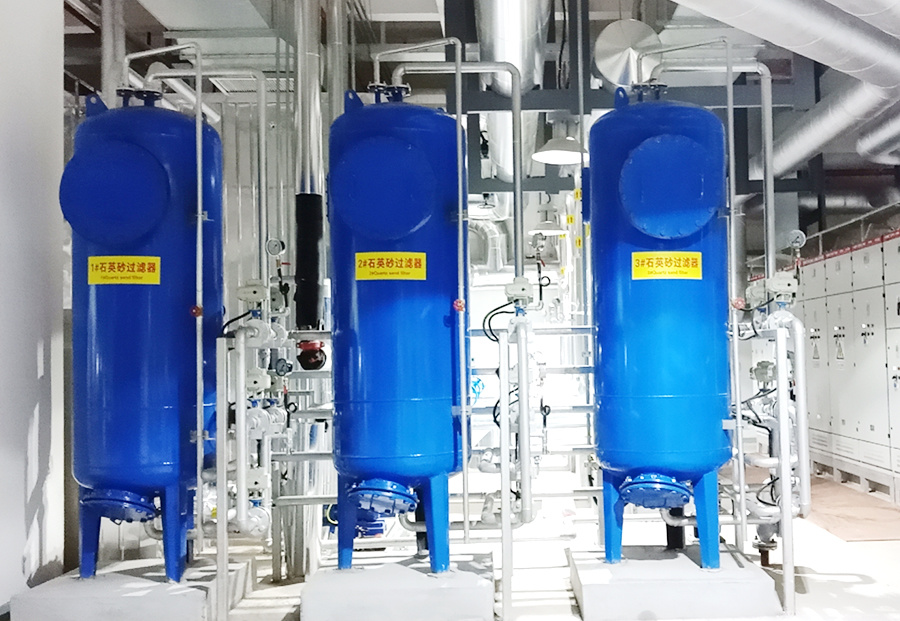
Water softening equipment, as the name suggests, is equipment that reduces water hardness, mainly removing calcium and magnesium ions in water, in layman's terms, it is equipment that reduces water hardness. Its main functions include removing calcium and magnesium ions in water, activating water quality, sterilizing and algaeciding, and preventing and removing scale. Water softening equipment cannot reduce the total salt content in water during the water softening process. It is widely used in hot water boiler systems, heat exchange systems, industrial cooling systems, central air conditioning systems, and other water-using equipment systems.
Working principle
Since the hardness of water is mainly formed and represented by calcium and magnesium, cation exchange resin is generally used (water softener) to replace Ca2+ and Mg2+ (the main components forming scale) in water. As the increase of Ca2+ and Mg2+ in the resin, the efficiency of the resin removing Ca2+ and Mg2+ gradually decreases.
When the resin absorbs a certain amount of calcium and magnesium ions, it must be regenerated. The regeneration process is to rinse the resin layer with brine in the salt tank to displace the hardness ions on the resin and discharge them out of the tank with the regeneration waste liquid, and the resin will restore its softening exchange function.
Since the hardness of water is mainly formed and represented by calcium and magnesium Since the hardness of water is mainly formed and represented by calcium and magnesium The principle of sodium ion exchange softening treatment is to pass the raw water through sodium-type cation exchange resin, so that the hardness components in the water Ca2+ and Mg2+ are exchanged with Na+ in the resin, thereby adsorbing Ca2+ and Mg2+ in the water, softening the water.
Workflow
Work The process involves five steps: backwashing, salting (regeneration), slow rinsing (displacement), and fast rinsing. Different water softening equipment has very similar processes, with only minor additional steps due to differences in actual processes or control needs. Any water softening equipment based on sodium ion exchange is developed based on these five processes (among them, fully automatic water softening equipment will add a brine recharge process).
Backwashing: After operating for a period of time, the equipment will intercept many impurities from the raw water at the top of the resin. After removing these impurities, the ion exchange resin can be fully exposed, and the regeneration effect can be guaranteed. The backwashing process is the process of washing water from the bottom of the resin and flowing out from the top, which can flush away the impurities intercepted at the top. This process generally takes about 5-15 minutes.
Salting (regeneration): This is the process of injecting brine into the resin tank. Traditional equipment uses a salt pump to inject brine, while fully automatic equipment uses a dedicated built-in injector to draw in brine (as long as the incoming water has sufficient pressure). In actual operation, the regeneration effect of brine flowing through the resin at a slower speed is better than simply soaking the resin in brine. Therefore, water softening equipment regenerates by using the method of slowly flowing brine through the resin. This process generally takes about 30 minutes, and the actual time is affected by the amount of salt used.
Slow Rinse (Displacement): The process of slowly rinsing the resin with raw water at the same flow rate after passing brine through the resin to completely remove all the salt from the resin is called slow rinsing. Due to the large number of calcium and magnesium ions on the functional groups being exchanged with sodium ions during this rinsing process, based on practical experience, this process is the main regeneration process, so many people call this process displacement. This process generally takes the same time as salt absorption, i.e., about 30 minutes.
Fast Rinse: In order to thoroughly rinse away the residual salt, raw water is used to rinse the resin at a flow rate close to the actual working flow rate. The final effluent of this process should be qualified softened water. Generally, the fast rinse process is 5-15 minutes.
Applications
Different applications require different water softening equipment.
1. Application range of water softening equipment:
① Heating
② Cooling water replenishment
③ Process water
④ Steam boiler
⑤ Iron and steel smelting
⑥ Chemical and pharmaceutical manufacturing
2. System water usage time required by the industry
System water usage time refers to: hourly water consumption, average value, and peak value. Equipment can be selected based on the water supply time. If continuous water supply is not required, single-valve single-tank equipment can be selected. ;If continuous water supply is required, double-bed centralized control or double-control double-bed series water softening treatment equipment should be selected.
3. Water source hardness
For the same model of water softener, the water with higher hardness will inevitably have a shorter water production cycle and lower water output, leading to frequent regeneration of the water softening equipment and thus reducing the service life of the resin. In this case, a larger model of water softener should be selected to increase the resin volume.
Water Softener Equipment Selection
① Controller: Divided into automatic control and manual control. For brands, you can choose imported or domestic ones.
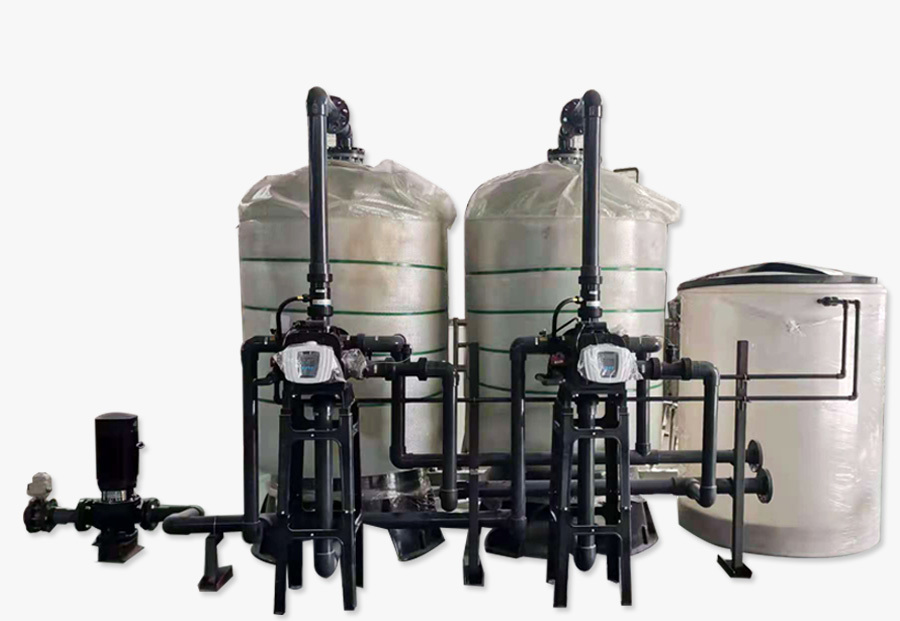
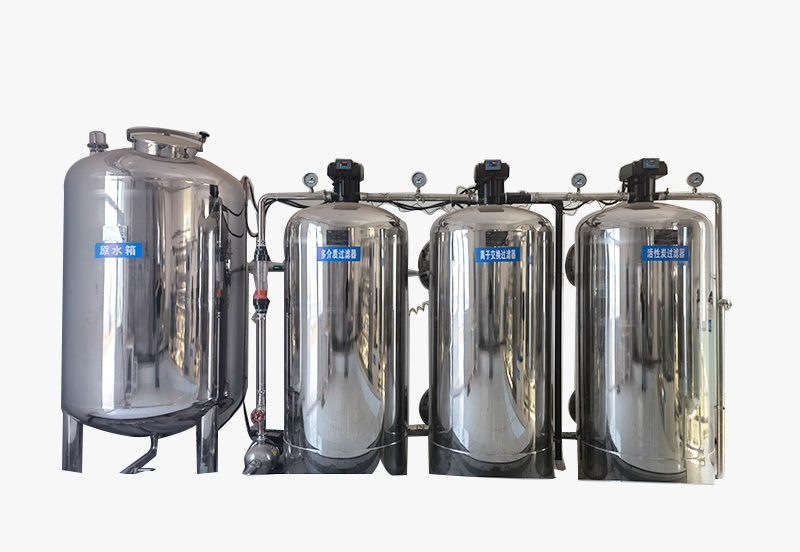
② Resin tank: The tank material of the water softening equipment is divided into fiberglass reinforced plastic, carbon steel, and stainless steel.
③ Equipment control mode: One is automatic regeneration when the prepared water volume reaches the set value, which is called flow type; suitable for all water supply system water softening equipment. The second is a time-controlled regeneration metering method, which is called time type; suitable for water supply systems with stable water volume, with the shortest regeneration cycle of 24 hours.
④ Equipment combination:
Single control single bed: Water supply stops during regeneration 2 hours or continue supplying raw water (hard water bypass).
Single control double bed: Alternating water supply, one working and one standby.
Double control double bed: Alternating water supply, one working and one standby.
Double control double bed: Simultaneous water supply, alternating regeneration.
Multiple control multiple beds: Three or more water softening resin tanks are used in parallel, suitable for large water supply systems.
It can be widely used in the softening of make-up water for steam boilers, hot water boilers, exchangers, evaporative condensers, air conditioners, and direct combustion engines. It can also be used for the treatment of domestic water in hotels, restaurants, office buildings, apartments, and homes, as well as water softening treatment in the food, beverage, brewing, laundry, dyeing, chemical, and pharmaceutical industries.
Technical Indicators
1. Inlet pressure: 0.2~0.5Mpa
2. Raw water hardness: <12mmol/L (When the raw water hardness is >8mmol/L, special design should be made according to the water quality of different regions)
3. Effluent hardness: <0.03mmol/L (meeting the requirements of GB1576-2001, National Standard for Low-Pressure Boiler Water Quality);
4. Raw water salinity <1500mg/L, turbidity <5, iron ion <0.3mg/L
5. Power supply: ~220V, 50HZ
6. Salt consumption <100g/equivalent (related to raw water hardness);
7. Water consumption <2%; Power consumption <50W Main technical specifications of fully automatic water softening desalination equipment
Tags:
-- Recommended --


Shijiazhuang Tianwang Environmental Protection Technology Co., Ltd.
Shijiazhuang Tianwang Environmental Protection Technology Co., Ltd. is a high-tech enterprise specializing in the research and development, manufacturing and sales of water treatment equipment.
Contact Information
Production address: No. 9, Fengchan Road, Economic and Technological Development Zone, Shijiazhuang City
Office Address: 25th Floor, Block C, No. 310 Changjiang Avenue, Shijiazhuang High-tech Development Zone
Contact Number:
0311-89272359 0311-68039237
Enterprise Email:
twhbkj@163.com
Website: en.sjztwhb.com