
Introduction to Disc Tube Reverse Osmosis (DTRO) Technology
Category:
Time of issue:2021-03-16
I. Disc tube membrane module DT membrane technology, also known as disc tube membrane technology, is divided into two categories: DTRO (disc tube reverse osmosis) and DTNF (disc tube nanofiltration). It is a patented membrane separation device. Its membrane module structure is completely different from the traditional spiral wound membrane.
1. Raw liquid flow path The disc tube membrane module has a patented flow path design, using an open flow path. The feed liquid enters the pressure vessel through the inlet, flows from the channel between the distributor and the shell to the other end of the module, and at the other end flange, the feed liquid enters the distributor through 8 channels. The treated liquid flows quickly through the filter membrane with the shortest distance, then reverses 180° to the other membrane surface, and then flows from the groove in the center of the distributor to the next distributor, thus forming a double "S" shaped route from the circumference of the distributor to the center, then to the circumference, and then to the center on the membrane surface. The concentrate finally flows out from the feed end flange. The distance between the two distributors of the DT module is 4 mm, and the surface of the distributor has a certain arrangement of convex points. This special hydrodynamic design makes the treated liquid form turbulence when it collides with the convex points when flowing through the filter membrane surface under pressure, increasing the permeation rate and self-cleaning function, thus effectively avoiding membrane fouling and concentration polarization, and successfully extending the service life of the membrane; it is also easy to clean the fouling on the membrane during cleaning, ensuring that the disc tube membrane module is suitable for treating wastewater with high turbidity and high sand content, and adapting to more severe influent conditions.

2. Permeate flow path The filter membrane is composed of two concentric annular reverse osmosis membranes, with a layer of filamentous support in the middle, allowing the purified water passing through the membrane to flow quickly to the outlet. The outer ring of these three layers of annular materials is welded using ultrasonic technology, and the inner ring is open, serving as the purified water outlet. The permeate flows along the filamentous support in the middle of the membrane to the permeate channel outside the central pull rod, and the O-ring on the distributor prevents raw water from entering the permeate channel; the distance from the membrane to the center of the permeate is very short, and it is equal for all filter membranes in the module.

II. Two-stage DTRO process
The two-stage DTRO process is based on the application of disc tube reverse osmosis membrane technology. Its core technology lies in the unique structural form of the disc tube reverse osmosis membrane, which makes it possible for the reverse osmosis membrane to directly treat high-concentration wastewater. It is a stable and reliable treatment technology with the characteristics of low investment, high degree of self-control, simple operation and maintenance, low operating costs, and stable and continuous compliance with emission requirements. Specifically:
In addition, raw water tanks, pumps, and valves used for adjusting the acidity of raw water and adjusting the alkalinity of effluent are also standardized complete sets of equipment, all of which are processed, installed, and debugged in the factory; after arriving at the site and being hoisted into place, they can be debugged and put into operation quickly.

(2) Strong process stability, simple maintenance, and low energy consumption. Because there are few factors affecting the retention rate of the membrane system, the effluent water quality is very stable and is not affected by factors such as biodegradability and nitrogen ratio; the DT membrane modules used in the process adopt standardized design, and the modules are easy to disassemble and maintain. Opening the DT module allows easy inspection and maintenance of any filter membrane and other components, making maintenance simple. When the number of components is insufficient, the module allows for fewer membranes and distributors to be installed without affecting the use of the DT membrane module. The DT membrane module effectively avoids membrane scaling, reduces membrane fouling, and extends the life of the reverse osmosis membrane. The special structure and hydrodynamic design of DT make the membrane module easy to clean, and the flux recovery after cleaning is very good, thus extending the life of the membrane. Practical engineering shows that in the treatment of渗沥液原液, the life of the first-stage DT membrane can be as long as 3 years or even longer, and the life can be up to more than 5 years when connected to other treatment facilities (such as MBR), which is unattainable for general reverse osmosis treatment systems. In this process, it is not necessary to achieve the ultimate removal of pollutants, only separation, so the operating energy consumption is greatly reduced; any single component inside the DT module can be replaced individually. The filtration part is assembled from multiple filter membranes and distributors. When the filter membranes need to be replaced, they can be replaced individually. For membranes with good filtration performance, they can still be used, which minimizes the cost of membrane replacement.
(3) Good effluent water quality. Reverse osmosis membranes have a very high removal rate for various pollutants, and the effluent water quality is good. Currently, the main applications are single-stage (in series after biological effluent) and two-stage DTRO, which can fully meet various reuse or discharge standards.
(4) Flexible operation. As a physical separation device, the DTRO system is very flexible to operate. It can operate continuously or intermittently, and the series-parallel mode of the system can be adjusted to adapt to the requirements of water quality and quantity.
(5) Short construction period, rapid commissioning and start-up. The core components of the two-stage DTRO process are assembled in the factory, with supporting workshops and water pools, the scale is very small, and the construction speed is fast. After the equipment arrives at the site, the installation and commissioning work can be completed in about two weeks. (6) High degree of automation, simple operation and operation. The process system is fully automatic, and the entire system has a complete monitoring and control system. The PLC can automatically adjust according to the sensor parameters and issue alarm signals in a timely manner to protect the system. Operators only need to find error codes and troubleshoot according to the operation manual, and there are no excessive requirements for the experience of operators. (7) Small footprint. The core equipment of the two-stage DTRO process is integrated installation, and the auxiliary structures and facilities are also some small structures, so the footprint is very small. (8) Reusable. The core component of the two-stage DTRO process is the DTRO integrated equipment, which is easy to move and install, and the overall service life of the equipment is more than 20 years. After the completion of one project, it can be moved to other projects for continued use.
III. Process flow and description
1. Process flow

2. Process description
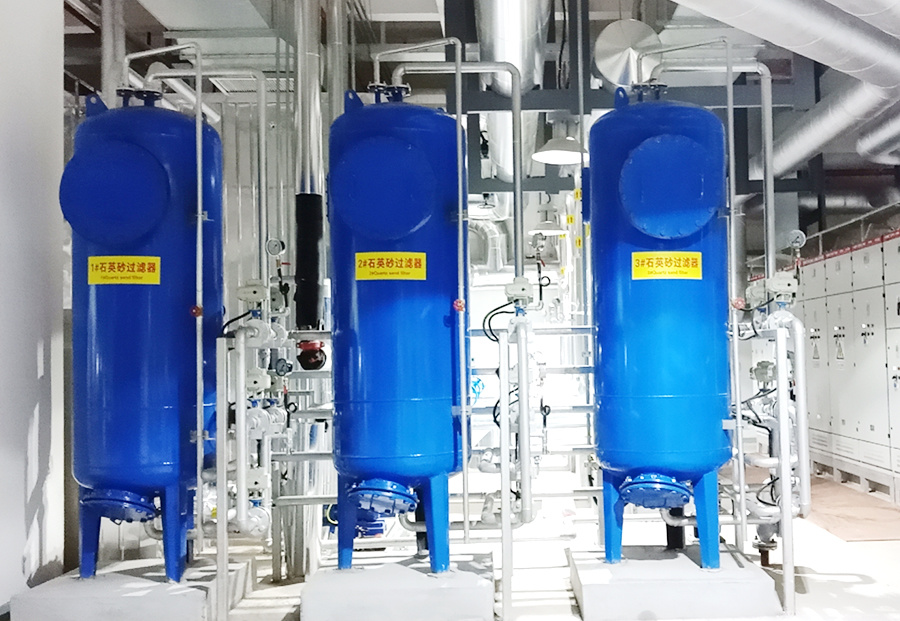
(1) Pretreatment of high-concentration wastewater Due to differences in factory conditions and pretreatment processes, the composition of high-concentration wastewater is complex and contains various sparingly soluble salts such as calcium, magnesium, barium, and silicon. These sparingly soluble inorganic salts, when entering the reverse osmosis system, are highly concentrated. When their concentration exceeds the solubility under these conditions, scaling will occur on the membrane surface. Adjusting the raw water effectively prevents scaling of carbonate inorganic salts; therefore, the pH value of the raw water must be adjusted before entering the reverse osmosis system. The water from the adjustment tank is pumped into the raw water tank of the reverse osmosis system. The pH is adjusted by adding acid in the raw water tank. The water from the raw water tank is pressurized by the raw water pump before entering the quartz sand filter. The number of sand filters is determined according to the specific treatment scale, and the filtration accuracy is 50μm. There are pressure gauges at the inlet and outlet of the sand filter. When the pressure difference exceeds 25 bar, the backwashing procedure must be performed. The frequency of backwashing the sand filter depends on the suspended solids content of the influent. For general wastewater, the backwashing cycle of the sand filter is about 100 hours. For raw water with a relatively low SS value, if the pressure difference does not exceed 25 bar after 100 hours of sand filter operation, backwashing must also be performed to avoid excessive compaction and bonding of the quartz sand. The earlier time of the two automatically activates the sand filter backwashing time. The sand filter is washed with raw water; air washing uses compressed air generated by a rotary vane compressor. After the sand filter, the water enters the cartridge filter. For leachate treatment systems, due to the high content of calcium, magnesium, barium, and other easily scaling ions and silicates in the raw water, these salts easily become supersaturated on the concentrate side after high-concentration by the DT membrane module. Therefore, according to the actual water quality, a certain amount of scale inhibitor is added before the cartridge filter to prevent silicate and sulfate scaling. The specific amount added is determined by the raw water quality analysis. The scale inhibitor should be diluted with 20 times the amount of water before use. The cartridge filter provides the final protective barrier for the membrane column. The accuracy of the cartridge filter is 10μm. Similarly, the number of cartridge filters is determined according to the specific treatment scale, just like the sand filter.

(2) Two-stage DTRO system process flow This system is a two-stage reverse osmosis system. The first stage of reverse osmosis requires water from the cartridge filter, and the second stage of reverse osmosis treats the permeate from the first stage. The water from the raw water storage tank is supplied to the reverse osmosis equipment by a pump, and the sand filter booster pump provides pressure to the raw water. There is one sand filter. There are pressure gauges at the inlet and outlet of the sand filter. When the pressure difference exceeds 25 bar, the backwashing procedure must be performed. The frequency of backwashing the sand filter depends on the suspended solids content of the influent. During backwashing, air washing is performed first using an air pump, followed by washing using a pump. The filtration accuracy of the sand filter is 50μm. After the sand filter, the raw water directly enters the cartridge filter. The equipment is equipped with two cartridge filters. There are pressure gauges at the inlet and outlet of the cartridge filters. When the pressure difference exceeds 20 bar, the filter cartridges are replaced. The filtration accuracy of the cartridge filter is 10μm, providing the final protective barrier for the membrane column. In order to prevent various sparingly soluble sulfates and silicates from scaling due to high-concentration in the membrane module and effectively extend the membrane service life, a certain amount of scale inhibitor must be added before the first-stage reverse osmosis membrane. The amount added is determined according to the concentration of sparingly soluble salts in the raw water. The raw water that has passed through the cartridge filter directly enters the first-stage reverse osmosis high-pressure plunger pump. Each plunger pump in the DT membrane system has a shock absorber to absorb the pressure pulses generated by the high-pressure pump and provide stable pressure to the membrane column. The water after the high-pressure pump enters the membrane module. The membrane module uses a disc tube reverse osmosis membrane column, which has the advantages of strong anti-fouling properties and good material exchange effect, and is highly adaptable to leachate. The service life of the first-stage DTRO membrane can reach more than 3 years, and the service life of the second-stage DTRO membrane is up to 5 years. Two sets of first-stage reverse osmosis systems are planned, connected in series. The concentrate from the first set of reverse osmosis enters the second set connected in series. The COD concentration and salt content of the concentrate treated by each set increase sequentially. One set of second-stage reverse osmosis is set up. The water from the shock absorber of the first-stage reverse osmosis enters the first membrane group. The first group is directly supplied with water by a high-pressure pump, and the second membrane column is equipped with an online circulation pump to generate sufficient flow rate and flow velocity to overcome membrane fouling. The second-stage reverse osmosis does not require an online booster pump. Because its influent conductivity is relatively low and the recovery rate is relatively high, only a high-pressure pump can meet the requirements. The effluent from the membrane column group is divided into two parts. The permeate from the first-stage reverse osmosis is discharged to the inlet of the second-stage reverse osmosis, and the concentrate is discharged into the concentrate storage tank. The permeate from the second-stage reverse osmosis enters the clean water storage tank, waiting for reuse, and the concentrate enters the inlet of the first-stage reverse osmosis for further treatment. Each concentrate side of the two-stage reverse osmosis has a pressure regulating valve to control the pressure in the membrane group to generate the necessary clean water recovery rate.

(3) Clean water degassing and pH adjustment Because high-concentration wastewater contains a certain amount of dissolved gas, and the reverse osmosis membrane can remove dissolved ions but not dissolved gases, it may cause the pH value of the reverse osmosis membrane water to be slightly lower than the discharge requirement. After the dissolved acidic gases in the permeate are removed by the degassing tower, the pH value can significantly increase. If the pH value of the clean water after the degassing tower is still lower than the discharge requirement, the system will automatically add a small amount of alkali to adjust the pH value to the discharge requirement. Because the effluent is degassed by the degassing tower, only a small amount of alkali solution is needed to meet the discharge requirements. The effluent pH adjustment is carried out in the clean water tank. A pH sensor is installed in the clean water discharge pipe. The PLC judges the effluent pH value and automatically adjusts the frequency of the metering pump to adjust the amount of alkali added, so that the final effluent pH value meets the discharge requirements.
(4) Equipment rinsing and cleaning Membrane module cleaning includes rinsing and chemical cleaning. The reverse osmosis system has cleaning agent A, cleaning agent B, scale inhibitor, and cleaning buffer tank. Operators need to regularly add cleaning agents and scale inhibitors to the storage tanks and set the cleaning execution time. When cleaning is needed, the system automatically performs system rinsing: Membrane module rinsing is performed every time the system is shut down. When it is necessary to shut down during normal operation, a rinsing-before-shutdown mode is generally adopted. When a system malfunction occurs and the system automatically shuts down, the rinsing procedure is also executed. The main purpose of rinsing is to prevent pollutants in the raw water from depositing on the membrane surface. There are two types of rinsing: one is rinsing with raw water, and the other is rinsing with clean water. The time for both types of rinsing can be set on the operating interface, generally 2-5 minutes.
Tags:
-- Recommended --


Shijiazhuang Tianwang Environmental Protection Technology Co., Ltd.
Shijiazhuang Tianwang Environmental Protection Technology Co., Ltd. is a high-tech enterprise specializing in the research and development, manufacturing and sales of water treatment equipment.
Contact Information
Production address: No. 9, Fengchan Road, Economic and Technological Development Zone, Shijiazhuang City
Office Address: 25th Floor, Block C, No. 310 Changjiang Avenue, Shijiazhuang High-tech Development Zone
Contact Number:
0311-89272359 0311-68039237
Enterprise Email:
twhbkj@163.com
Website: en.sjztwhb.com