

Technical Section: What aspects of knowledge does water treatment technology cover?
Category:
Time of issue:2020-01-10

China's water treatment technology has developed over more than two decades, from the treatment of circulating cooling water to comprehensive sewage treatment, and from physical treatment to comprehensive physical, chemical, and biochemical treatment technologies. This provides a technological guarantee for the safe and rational use of water and has played a huge role in energy conservation, emission reduction, and environmental protection.
I. Physical Treatment Methods
Physical treatment, also known as mechanical treatment, mainly separates and recovers undissolved suspended pollutants in water through physical means. Common methods include screening and filtration, sedimentation and flotation, and filtration.
1 Screening and filtration is divided into bar screens and screens;
Bar screens: Used to intercept large suspended solids and floating matter in water to prevent clogging of pumps and sludge discharge pipes in sedimentation tanks.
Screens: Used to intercept finely suspended matter ranging in size from a few millimeters to tens of millimeters, especially suitable for separating and recovering fibrous suspended matter, animal and plant remains, and debris in wastewater.
2 Sedimentation and flotation are divided into sedimentation and flotation;
Sedimentation: Used to remove settleable solid particles larger than 20-100nm. For colloidal particles and fine suspended solids with a particle size of 100-10000nm a coagulant must first be added to destroy their stability, causing them to aggregate into flocs of hundreds of micrometers to several millimeters in size, before they can be removed by conventional solid-liquid separation methods such as sedimentation, filtration, and flotation.
Flotation: In water treatment, the density difference is often used to separate low-density solid or oil pollutants in wastewater using flotation or air flotation. This method can remove oil droplets larger than 60μm, as well as most solid particulate pollutants.
3 Filtration is divided into bar screen filtration, microfiltration, and depth filtration;
Bar screen filtration: The filter medium is a bar screen or filter screen, used to remove large suspended solids such as weeds, rags, fibers, and pulp. Typical equipment includes bar screens, screens, and pipe filters.
Microfiltration: Uses formed filter materials such as filter cloths, filter sheets, sintered filter tubes, and honeycomb filter cartridges to remove fine particles.
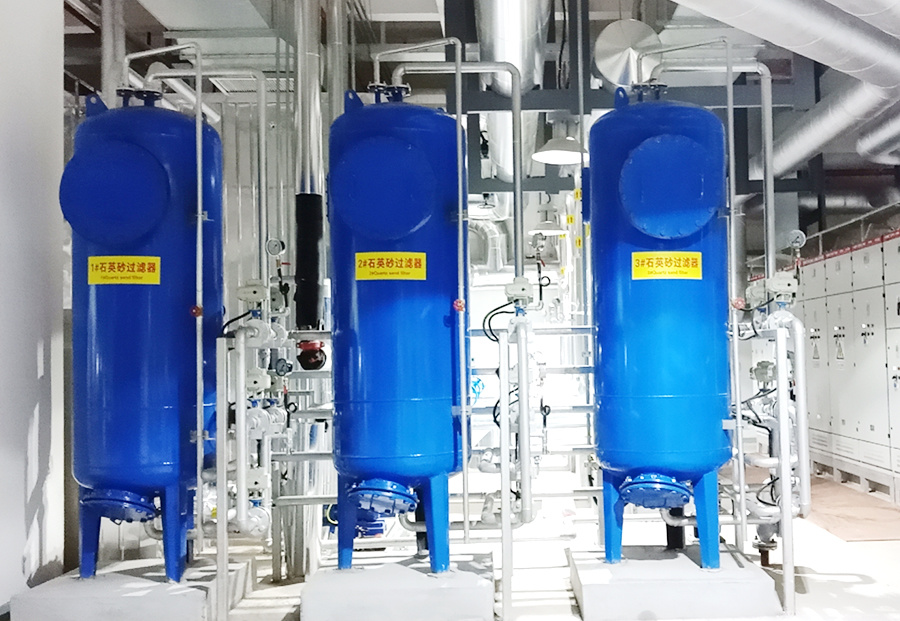
Depth filtration: Uses granular filter media such as quartz sand and anthracite. Due to the pores between the filter particles, when the raw water passes through a certain depth of the filter layer, the suspended matter in the water is intercepted.
II. Chemical Treatment Methods
Chemical treatment mainly uses chemical reactions to meet water quality requirements, such as pH adjustment, flocculation reaction, and water quality stabilization of circulating water.
1 Water quality stabilization: Scale inhibition, corrosion inhibition, and disinfection and algae control;
Scale inhibition: The process of preventing the formation of deposits on the heating surfaces of heat exchange equipment using chemical methods, generally used in circulating cooling water treatment.
Corrosion inhibition: The process of inhibiting or slowing down the corrosion of metals. Corrosion inhibitors are generally added in circulating cooling water treatment.
Disinfection and algae control: Inhibiting the growth of bacteria and algae and the production of microbial sludge in water by adding disinfectants and algicides.
2 Coagulation: Mixing reaction and flocculation reaction;
Mixing reaction: The process of adding coagulants to destabilize the compressed double layer of fine suspended particles or colloids in water.
Flocculation reaction: The process of forming large flocs from aggregates by adding high molecular weight polymers.
3 Neutralization: Chemical neutralization and filtration neutralization;
Chemical neutralization: Adding acid or alkali agents to maintain the water pH value within a certain range.
Filtration neutralization: Alkaline filter materials are used to fill a filter bed of a certain form, and acidic wastewater flowing through this bed is neutralized.
4 Oxidation-reduction: Chemical oxidation and chemical reduction.
Chemical oxidation: Adding chemical oxidants can remove reducing ions in water.
Chemical reduction: Some metal ions in water in a high valence state are reduced to a low valence state using chemical reduction.
III. Physicochemical Methods
Physicochemical treatment is a treatment method that uses physicochemical actions to remove pollutants from water. Common physicochemical methods in water treatment include ion exchange, membrane separation, and electro-adsorption. 。
Ion exchange: Using solid ion exchangers to exchange ions in a dilute solution to extract or remove certain ions from the solution. This is a unit operation belonging to mass transfer separation processes.
Membrane separation: Using a special semi-permeable membrane as a filter medium to filter under a certain driving force. Due to the extremely small and selective pores of the filter membrane, bacteria, viruses, organic matter, and dissolved solutes in water can be removed. The main equipment includes reverse osmosis, ultrafiltration, and electrodialysis.
Electro-adsorption: Utilizing the phenomenon of adsorption of ions and charged particles in water on the surface of charged electrodes, dissolved salts and other charged substances in water are enriched and concentrated on the electrode surface to achieve water purification and desalination, a new type of water treatment technology.
IV. Biochemical Methods
Biochemical methods utilize the metabolic action of microorganisms to convert dissolved and colloidal organic pollutants in wastewater into harmless substances to achieve purification. They can be divided into aerobic and anaerobic biological treatment methods.
Anaerobic treatment: Under anaerobic conditions, various complex organic substances in wastewater are decomposed and converted into substances such as methane and carbon dioxide by the action of anaerobic microorganisms.
Aerobic treatment: Using aerobic microorganisms to perform biological metabolism in the presence of oxygen to degrade organic matter.
Tags:
-- Recommended --


Shijiazhuang Tianwang Environmental Protection Technology Co., Ltd.
Shijiazhuang Tianwang Environmental Protection Technology Co., Ltd. is a high-tech enterprise specializing in the research and development, manufacturing and sales of water treatment equipment.
Contact Information
Production address: No. 9, Fengchan Road, Economic and Technological Development Zone, Shijiazhuang City
Office Address: 25th Floor, Block C, No. 310 Changjiang Avenue, Shijiazhuang High-tech Development Zone
Contact Number:
0311-89272359 0311-68039237
Enterprise Email:
twhbkj@163.com
Website: en.sjztwhb.com