
Operating conditions and commissioning of reverse osmosis equipment
Category:
Time of issue:2020-05-26
pH value: 3~10
Residual chlorine: <0.1mg/L
SDI15 value: <5.0
Water temperature: <45 ℃
If any of the above indicators exceed the range, it may cause the membrane to deform, affecting the quality of the effluent water and shortening the service life of the membrane. Different types of membranes have different requirements for influent water quality. Confirmation can be obtained from the RO membrane manufacturer's instructions before commissioning.

Reverse Osmosis Equipment Pre-operation Preparation
As RO is a high-pressure operating equipment, to protect the equipment, instruments, and safety before operation, the valve opening status should be strictly confirmed and adjusted according to the operating procedure. The specific operation is as follows:
1. Fully open the safety filter inlet valve and the high-pressure pump inlet valve.
2. Open the high-pressure pump outlet valve one turn.
3. Open the RO inlet valve one turn.
4. Rotate the needle valve on the concentrate pipe three and a half turns.
5. Fully open the product water outlet valve and the concentrate outlet valve.
6. Close all sampling valves and cleaning valves.
7. Open all pressure display valves to a half-open state.
Reverse Osmosis Equipment Trial Run and Commissioning
When all the above conditions are met, the high-pressure pump can be started for trial operation. Since RO is also a liquid-liquid separation device, water can only pass through the reverse osmosis membrane and achieve desalination when the water supply pressure is higher than the osmotic pressure. The driving force for this phenomenon comes from the pressure difference (ΔP) between the water supply (concentrate) pressure and the osmotic pressure (which varies with the type and model of the RO membrane). This ΔP can be adjusted and controlled by the stop valve (valve 5) installed at the RO inlet and the pressure regulating needle valve (valve 13) installed on the concentrate pipeline. First, adjust the total influent volume (sum of readings of flow meter 11 and flow meter 12) to the design influent volume using the RO inlet stop valve. Then, use the pressure regulating needle valve (valve 13) to accurately adjust the product water flow rate and concentrate pressure. If the product water flow rate is less than the design value, it indicates that the water supply (concentrate) pressure is too low, that is, the ΔP value is too small. In this case, the needle valve should be closed slightly to increase the concentrate (influent) pressure until the product water flow rate equals the design value.
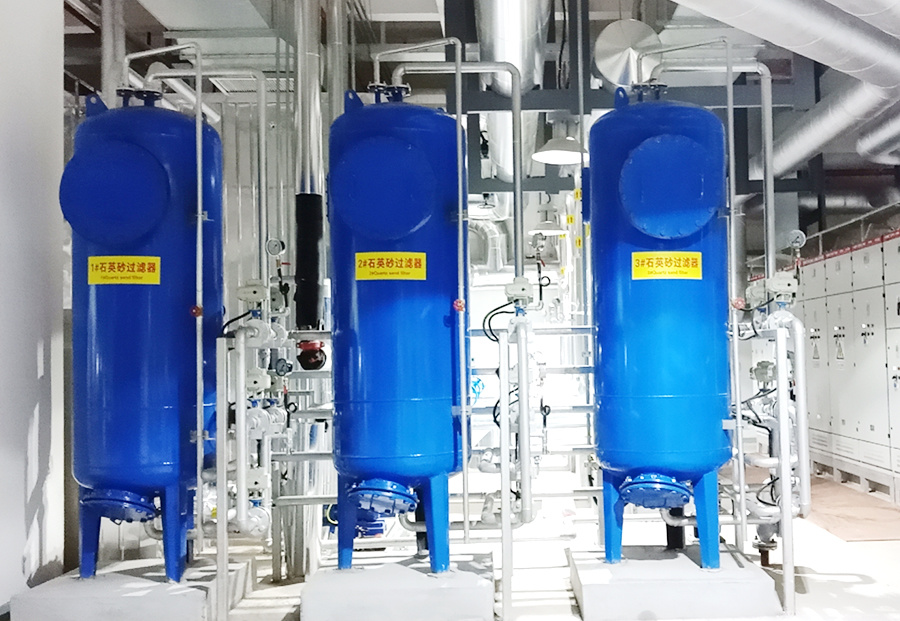
The permeate water treatment equipment is divided into two parts: pre-treatment commissioning and reverse osmosis main unit commissioning. Pre-treatment mainly involves the forward and reverse washing of quartz sand and activated carbon to remove fine sand, carbon, and impurities, and controlling the influent water volume. Reverse osmosis main unit commissioning mainly involves adjusting the influent and effluent flow rate and pressure. In summary:
1. Analyze and test the influent to the device. Commissioning can only proceed if the results show that the influent meets the requirements.
2. Adjust the pressure control system of the high-pressure pump.
3. Check whether all pipe connections in the device are complete, whether pressure gauges are complete, and whether low-pressure pipe connections are tight and whether there are any shortages.
4. Fully open all pressure gauge switches, the total influent valve, concentrate discharge valve, and product water discharge valve.
5. Start the pre-treatment equipment and adjust the water supply to be greater than the total influent volume of the device.
6. Backwash and forward wash the sand and carbon filters until the effluent is clear.
7. Start the high-pressure pump and slowly open the total influent valve of the device, controlling the total influent pressure of the device to less than 0.5 MPa. Flush for 5 minutes and check whether all high and low pressure pipelines and instruments are normal.
8. Adjust the influent valve and concentrate discharge valve to bring the influent pressure to 1.0~1.4 MPa.
9. Detect the conductivity of the product water. When it meets the requirements, open the product water outlet valve and close the product water discharge valve.
10. The commissioning of the RO device is all manual single-step commissioning. After normal operation, it can be switched to automatic status and automatically controlled by online instruments and PLC.
11. Start the regeneration system to check whether the regeneration system is working properly.
Tags:
-- Recommended --


Shijiazhuang Tianwang Environmental Protection Technology Co., Ltd.
Shijiazhuang Tianwang Environmental Protection Technology Co., Ltd. is a high-tech enterprise specializing in the research and development, manufacturing and sales of water treatment equipment.
Contact Information
Production address: No. 9, Fengchan Road, Economic and Technological Development Zone, Shijiazhuang City
Office Address: 25th Floor, Block C, No. 310 Changjiang Avenue, Shijiazhuang High-tech Development Zone
Contact Number:
0311-89272359 0311-68039237
Enterprise Email:
twhbkj@163.com
Website: en.sjztwhb.com