

How exactly is high-salinity wastewater treated?
Category:
Time of issue:2020-06-03
With China's rapid economic development and the increasing discharge of high-salt wastewater, the difficulty of treating high-salt wastewater has increased. How to choose a high-salt wastewater treatment process? What are the advantages and disadvantages of high-salt wastewater treatment processes? How should these high-salt wastewaters be treated?
High-salt wastewater refers to wastewater containing organic matter and at least 3.5% (mass concentration) of total dissolved solids (TDS). This wastewater comes from a wide range of sources. One type is from various industrial production processes such as chemical, pharmaceutical, petroleum, papermaking, dairy processing, and food canning, which discharge a large amount of wastewater. The water contains not only high concentrations of organic pollutants but also a large amount of ions such as calcium, sodium, chlorine, and sulfate. Another type is that in order to make full use of water resources, some coastal cities directly use seawater as industrial production water or cooling water. 1. Chemical coagulation-flotation, sedimentation traditional pretreatment process
When the COD concentration of saline raw water is below 5000mg/L, and there is no requirement for the quality of crystalline salt, the traditional process is to pretreat the saline raw water through "adjustment-chemical coagulation-flotation, sedimentation", and then enter the "evaporation concentration crystallization desalination system". This method has a low investment and operating cost, but the quality of the crystalline salt is poor and difficult to sell.

2. Fenton or electro-Fenton catalytic oxidation pretreatment process
Fenton's reagent contains H2O2 and Fe2+, which has a strong oxidation capacity for organic pollutants in wastewater, and the reaction is fast, the investment is low, and the effluent can be pretreated after sedimentation and purification.
However, the Fenton or electro-Fenton catalytic oxidation process requires specific reaction conditions: pH value 2-4, and produces a lot of iron-containing sludge, and the effluent will have color. It is more economical to use when the pH value of the saline raw water is low, otherwise, the process of "adding acid to reduce pH, adding alkali to neutralize" will increase the operating cost. COD concentration around 10000 mg/L is better, if it is too high, multi-stage oxidation purification treatment is required, and the Fenton process has no advantage.
3. Double membrane pretreatment process
First, use a pore size of 20-2000Ao(10-6.5-10-4.5cm) semi-permeable membrane for ultrafiltration, which can retain proteins, various enzymes, bacteria, and other colloidal substances and macromolecules in the concentrate, while water, solvents, small molecules, and ions forming salts can pass through the membrane and enter the permeate.
Since the amount of permeate water is reduced, while the amount of salt remains unchanged, the salt concentration in the permeate water increases. Then use a pore size of 1-20Ao(10-7.5-10-6.5cm) semi-permeable membrane for reverse osmosis, inorganic salts, sugars, amino acids, BOD 、 COD etc. are retained in the concentrate, only water and solvent enter the permeate, and the salt concentration in the concentrate further increases, and is sent to evaporation crystallization desalination.
The advantage of double-membrane desalination is that it greatly reduces the amount of water for evaporation crystallization desalination, thus significantly reducing the operating cost and investment of evaporation crystallization desalination. However, the following issues should be noted:
Ultrafiltration needs to adjust pH to neutral, remove hardness, remove SS purification, etc.;
The salinity of the raw water is 5000mg/L below, otherwise the permeate water will be too low, and the desalination rate will also decrease;
Because the membrane needs to be frequently washed, acid-washed, and alkali-washed for protection, the service life of the membrane is also limited, and the operating cost is also relatively high;
The biggest problem is what to do with the retained higher-polluted concentrate?! If valuable substances can be extracted or a large amount of biodegradable wastewater can be diluted and treated together, it is fine, otherwise, reuse will increase pollution accumulation; if incineration, the investment and operating cost are extremely high;
For wastewater with a salt content exceeding 5000mg/L can be directly evaporated and crystallized for desalination, and there is no point in using membrane methods anymore, but it should be reminded that: effective pretreatment should still be carried out before evaporation crystallization desalination.
4. Ozone / catalytic / coagulation composite pretreatment process
Using ozone as a strong oxidant and combining catalysts and coagulants, sufficient cross-linking synergistic reactions can be carried out in a specific environment, which can break the ring chains and long chains in wastewater and improve the biodegradability of wastewater.
Creating suitable reaction conditions can also fully oxidize dissolved organic pollutants in wastewater, destroy colloids, chromophores, and odor groups in wastewater, and remove COD 、 BOD 、 SS odor and some colors, but cannot remove salt and a lot of ammonia nitrogen.
Because ozone is used as a strong oxidant and combined with oxidizing catalysts and coagulants, the amount of sludge produced in the whole process of removing organic pollutants is very small, and the reaction environment, form, and process are simpler than Fenton process, and can be operated in multi-stage series to ensure that the effluent meets the expected indicators.
Wastewater with a large water volume and a salt content below 5000mg/L can be preferentially selected for the double-membrane method, and then desalted after concentration;
Saline raw water pH value is 2-4 saline raw water can be preferentially selected Fenton process pretreatment;
pH value 5 above high concentration COD and with a salt content greater than 5000mg/L salt-containing wastewater can be treated with ozone / catalytic / coagulation and composite pretreatment process;
If the salt-containing raw water has high chromaticity or high ammonia nitrogen, it must be decolorized and deammoniated separately;
5. Evaporation crystallization desalination process
For salt-containing solutions, due to their different solubilities, there are two schemes for their crystallization from the solution. The first is for systems whose solubility does not change much with temperature, the solvent is generally evaporated. The second is for systems whose solubility changes significantly with temperature, the solution is generally cooled.
Salt-containing wastewater is generally a mixture of various salts. Due to the common ion effect, its solubility curve and boiling point are different from those of a single system. Generally, its saturated solubility is lower than that of a single system, and the boiling point is higher than that of a single system at the same concentration. Therefore, to accurately grasp the solubility and boiling point of multi-component salts, experiments must be conducted. This is the key to the design of evaporative desalination.
The design of the end point of evaporation and desalination concentration mainly depends on the matching of the subsequent separation equipment. If a horizontal spiral discharge centrifuge is used, the solid content of the solution from the evaporator should be 10% approximately. If a two-stage piston pusher centrifuge is used, the solid content of the solution from the evaporator is 50% approximately.
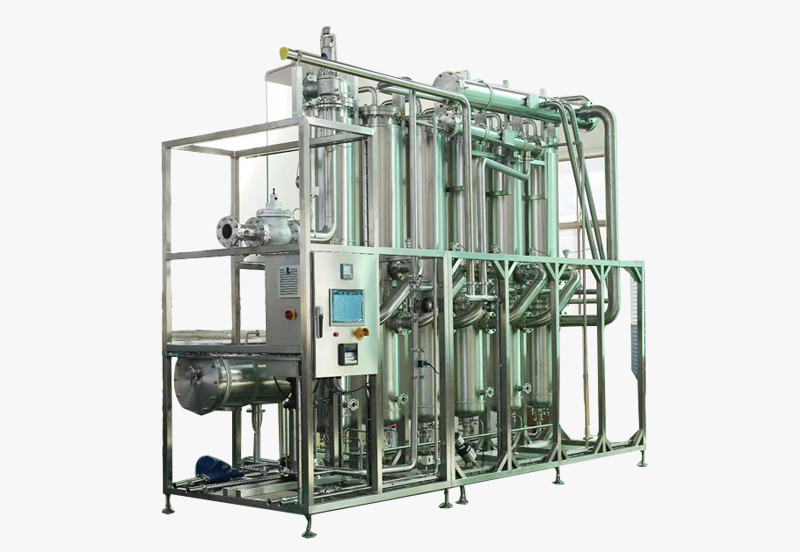
The design of the evaporation crystallizer is the key to the normal operation of the evaporation desalination device. The following factors should be considered during the design: crystal nucleus generation, supersaturation control, elimination of short-circuit temperature difference, immediate separation of large-particle salts, forced circulation method and flow rate, gas-liquid separation intensity, etc.
Tags:
-- Recommended --


Shijiazhuang Tianwang Environmental Protection Technology Co., Ltd.
Shijiazhuang Tianwang Environmental Protection Technology Co., Ltd. is a high-tech enterprise specializing in the research and development, manufacturing and sales of water treatment equipment.
Contact Information
Production address: No. 9, Fengchan Road, Economic and Technological Development Zone, Shijiazhuang City
Office Address: 25th Floor, Block C, No. 310 Changjiang Avenue, Shijiazhuang High-tech Development Zone
Contact Number:
0311-89272359 0311-68039237
Enterprise Email:
twhbkj@163.com
Website: en.sjztwhb.com