
Performance characteristics and maintenance tips for reverse osmosis purified water equipment
Category:
Time of issue:2020-10-09

I. Introduction to Reverse Osmosis Pure Water Equipment
Reverse osmosis equipment uses membrane separation technology to effectively remove charged ions, inorganic substances, colloidal particles, bacteria, and organic matter from water. It is the best equipment for high-purity water preparation, brackish water desalination, and wastewater treatment processes.
1. Equipment System Composition
A reverse osmosis pure water treatment system generally includes a pretreatment system, a reverse osmosis device, a post-treatment system, a cleaning system, and an electrical control system.
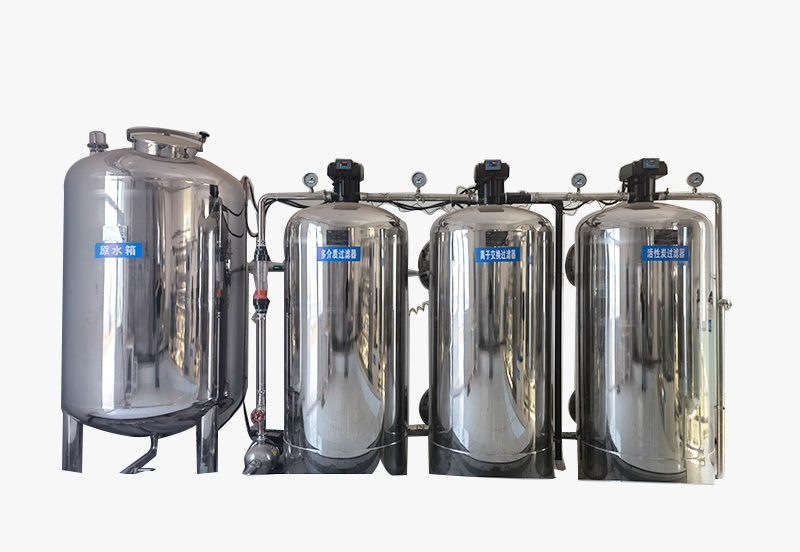
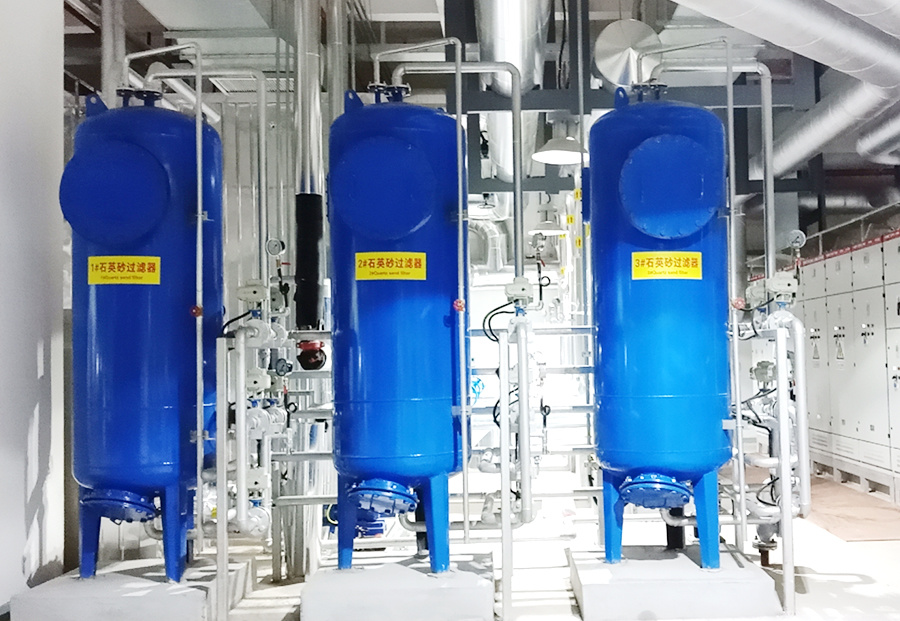
The pretreatment system generally includes a raw water pump, a dosing device, a quartz sand filter, an activated carbon filter, and a precision filter. Its main function is to reduce the pollution index and residual chlorine and other impurities in the raw water to meet the reverse osmosis water intake requirements.
The reverse osmosis device mainly includes a multi-stage high-pressure pump, reverse osmosis membrane elements, membrane shells (pressure vessels), and brackets. Its main function is to remove impurities from the water to meet the requirements of the effluent.
The post-treatment system is an additional configuration when reverse osmosis cannot meet the effluent requirements. It mainly includes one or more devices such as an anion bed, a cation bed, a mixed bed, sterilization, and ultrafiltration.
The cleaning system mainly consists of a cleaning water tank, a cleaning water pump, and a precision filter. When the reverse osmosis system is polluted and the effluent index cannot meet the requirements, the reverse osmosis needs to be cleaned to restore its effectiveness.
The electrical control system is used to control the normal operation of the entire reverse osmosis system. It includes instrument panels, control panels, various electrical protections, and electrical control cabinets.
2. Design Features
( 1) Deep filtration of water is achieved by increasing the pressure on the water. In addition to general filters, reverse osmosis pure water equipment also includes fine filters, granular activated carbon filters, and compressed activated carbon filters. Fine filters have a finer filtration function than general filters, and can better filter impurities in the water. As we know, activated carbon has a good adsorption and filtration function for odors and impurities. The reverse osmosis pure water equipment uses a double activated carbon filter to achieve deep filtration processing of the raw water, improving the filtration efficiency of the equipment. At the same time, increasing the water pressure to enhance the filtration capacity is also an innovation.
( 2) The core of the reverse osmosis pure water equipment is the application of reverse osmosis membranes. A reverse osmosis membrane is a filter membrane with an extremely small pore size. This membrane can be used to achieve ultra-fine filtration of raw water, and can also separate water into high and low concentrations. Water with a higher concentration can be recycled, and low-concentration water is pure water that can be used for human consumption.
3. Main Process Flow
( 1) Raw Water Tank
Stores raw water to allow for the sedimentation of large sand particles and other sedimentable substances. It also buffers the impact of unstable water pressure in the raw water pipe on the water treatment system (such as the response of pressure sensing caused by excessively low or high water pressure).
( 2) Raw Water Pump
Maintains a constant system water supply pressure and stable water supply volume.
( 3) Multi-Media Filter
A filter using multiple filter layers, the main purpose is to remove sand, rust, colloidal substances, suspended particles, etc. Substances above 20um can be removed. Manual valves or fully automatic controllers can be used for backwashing, forward washing, and other operations. This ensures the quality of the produced water and extends the service life of the equipment.
( 4) Activated Carbon Filter
The system uses a nutshell activated carbon filter. Activated carbon can not only adsorb electrolyte ions but also perform ion exchange adsorption. After activated carbon adsorption, the chemical oxygen demand (COD) can be reduced from 15mg/L(O2) to 2~7mg/L(O2). In addition, due to the adsorption effect, the concentration of the adsorbed copy on the surface increases, so it also plays a catalytic role, removing pigments, odors, a large number of biochemical organic substances, reducing the residual chlorine value of water, pesticides, and removing trihalomethanes (THM) and other pollutants. At the same time, the equipment has a self-maintenance system, and the operating cost is very low.
( 5) Ion Softening System
To prevent the concentration of dissolved solids from exceeding their equilibrium solubility constant and crystallizing out on the concentrate side, especially the last membrane module on the concentrate side of the RO device, damaging the membrane element's inherent properties, an ion softening device or an appropriate amount of scale inhibitor should be used before entering the reverse osmosis membrane module to prevent the crystallization of carbonates, SiO2, and sulfates.
( 6) Precision Filter
A precision filter is used to remove residual suspended matter, non-straight particles, and colloids in the incoming water. This makes the operation of subsequent equipment such as the RO system safer and more reliable. The filter element is a 5um melt-blown filter element, which aims to prevent impurities larger than 5um from being missed by the upper filtration unit. This prevents damage to the membrane surface and the desalination performance of the membrane.
( 7) Reverse Osmosis System
A reverse osmosis device uses sufficient pressure to separate the solvent (generally water) in the solution through a reverse osmosis membrane (or semi-permeable membrane). Because this process is opposite to the direction of natural osmosis, it is called reverse osmosis.
Reverse osmosis can adapt to raw water with various salt contents, especially in high-salt water treatment projects, it can achieve good technical and economic benefits. Reverse osmosis has a high desalination rate, high recovery rate, stable operation, small footprint, simple operation, and removes most bacteria, colloids, and high-molecular-weight organic matter while desalinating.
II. Maintenance and Maintenance Tips for Reverse Osmosis Pure Water Equipment
1. Strictly control the quality of the incoming water to ensure that the device operates under water quality conditions that meet the incoming water index requirements. If the incoming water quality does not meet the requirements, it is very easy to cause the reverse osmosis membrane to become clogged, causing the consumables to fail quickly and seriously affecting the quality of the effluent.
2. The total influent water volume of reverse osmosis is controlled by the RO influent regulating valve. If the reverse osmosis influent water volume does not change, do not adjust the RO influent regulating valve. It is strictly forbidden to fully open or fully close it. The RO drainage regulating valve is used to adjust the system recovery rate. If the recovery rate does not change, do not adjust the concentrate discharge regulating valve. It is absolutely forbidden to fully open or fully close it.
3. The device cannot be shut down for a long time. It should be operated for at least 2 hours per day. If it is to be shut down for more than 72 hours, the device should be chemically cleaned and filled with 1% sodium bisulfate and 18% glycerol for protection.
4. After each shutdown and startup of the reverse osmosis device, the device should be rinsed for 10 minutes under the condition that the inlet pressure is less than 0.4 MPa.
5. Regarding operating pressure control, under the premise of meeting the water production and water quality requirements, the lowest possible pressure value should be used. This helps to reduce the water flux attenuation of the membrane and reduce the membrane replacement rate.
6. Operators should record the operating parameters every hour to check the usage and effluent water quality of the pure water equipment.
The main recording contents are as follows:
( 1) Influent:
PH value, conductivity, pressure, SDI, water temperature.
( 2) Product water:
Conductivity, flow rate, PH value;
( 3) Concentrate:
Flow rate, pressure, and inlet pressure of each section.
7. When the reverse osmosis device has a high or low pressure alarm, first check if the manual valve opening between the security filter and the high-pressure pump is too small, then check if the RO influent regulating valve and concentrate discharge valve are normal, and then press the high/low pressure alarm reset button to restart the pure water production equipment.
8. Regarding influent temperature control, according to the actual water consumption, the lowest temperature that cannot meet the requirements of water production and water quality should be used as the influent temperature for that time period. This can reduce membrane water attenuation.
Tags:
-- Recommended --


Shijiazhuang Tianwang Environmental Protection Technology Co., Ltd.
Shijiazhuang Tianwang Environmental Protection Technology Co., Ltd. is a high-tech enterprise specializing in the research and development, manufacturing and sales of water treatment equipment.
Contact Information
Production address: No. 9, Fengchan Road, Economic and Technological Development Zone, Shijiazhuang City
Office Address: 25th Floor, Block C, No. 310 Changjiang Avenue, Shijiazhuang High-tech Development Zone
Contact Number:
0311-89272359 0311-68039237
Enterprise Email:
twhbkj@163.com
Website: en.sjztwhb.com