

Troubleshooting and daily maintenance of water softening equipment
Category:
Time of issue:2020-12-11

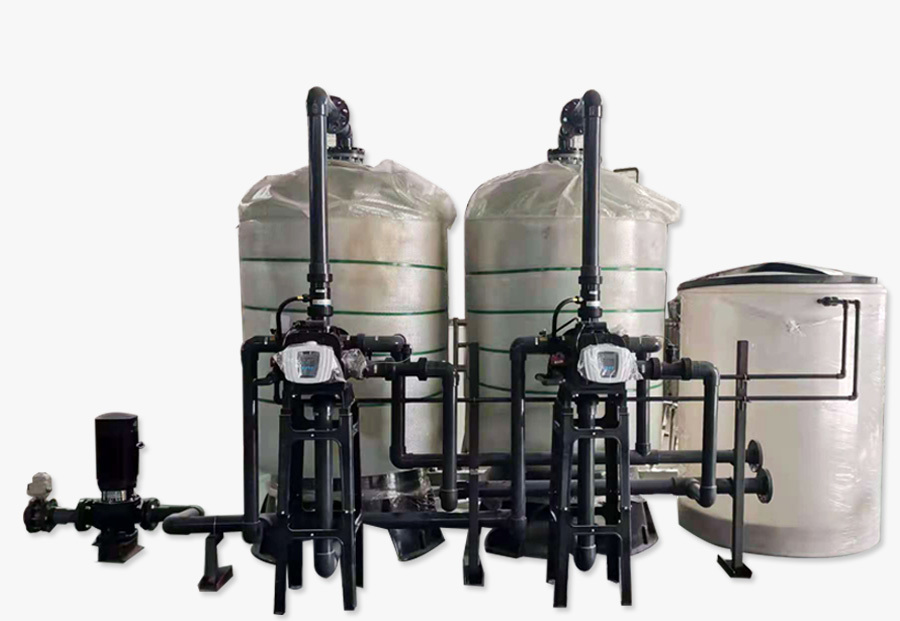
With the acceleration of industrialization, while productivity has increased, water pollution has become increasingly serious. Water softening and purification equipment are two common solutions to water pollution problems. The maintenance and troubleshooting of water equipment are complex but crucial. Only by mastering the correct maintenance methods can the maximum effect of water softening equipment be achieved.
Water Softener Maintenance
1. Operational Maintenance
The following maintenance work should be carried out during the operation of boiler water softening equipment and fully automatic water softeners:
① Ensure stable input voltage and current. Prevent moisture and water immersion. Prevent salt bridges from forming on the salt valve, and prevent damage to the electrical control device. A sealed cover should be installed on the outside of the electrical control device.
② Regularly add solid granular salt (strictly prohibit adding refined salt or iodized salt) to the salt tank. Ensure that the salt solution in the salt tank is in a supersaturated state. When adding salt, be careful not to spill solid granular salt into the salt well, which may block the salt suction pipe. Because solid granular salt contains a certain amount of impurities, a large amount of impurities will accumulate at the bottom of the salt tank, blocking the salt valve. Therefore, the impurities at the bottom of the salt tank should be cleaned regularly. During cleaning, open the drain valve at the bottom of the salt tank and rinse with clean water until no impurities flow out. The cleaning cycle of the salt tank should be determined according to the impurity content of the solid granular salt.
③ Regularly check the airtightness of the injector and salt suction pipeline to prevent leakage from affecting the regeneration effect.
④ Disassemble the water softener once a year. Clean the impurities in the upper and lower water distributors and the quartz sand cushion layer, check the resin consumption and exchange capacity, replace severely aged resin, and use hydrochloric acid solution to revive iron-poisoned resin.
2. Shutdown Maintenance
The resin should be fully regenerated before the water softener is temporarily shut down. Convert the resin to the sodium form for wet preservation. When shutting down in summer (e.g., water softeners for heating boilers are generally shut down for several months in summer), the water softener should be flushed at least once a month to prevent the growth of microorganisms in the exchange tank, which may cause the resin to mildew and clump. If mildew is found, sterilization treatment can be performed. Generally, soak in a 1% formaldehyde solution for several hours, then rinse with water until there is no formaldehyde odor. During winter shutdown, take antifreeze measures to prevent the water in the resin from freezing and causing the resin to expand, crack, and break. The resin can be stored in a brine solution, and the concentration of the brine should be adjusted according to the temperature conditions.
Troubleshooting of Boiler Water Softener Equipment
1. Water Softener Does Not Regenerate
Solution: Check if the power supply is normal, including checking fuses, plugs, switches, etc.; reset the time; check or replace the controller; check or replace the motor.
2. Water Softener Delivers Hard Water
Solution: a. Close or repair the bypass valve; b. Ensure there is solid salt in the salt tank; c. Replace or clean the injector; d. Check the salt tank water injection time; e. Ensure that the central pipe and O-ring are not cracked; f. Check and repair or replace the valve body; g. Correctly set and adjust the regeneration time or cycle water production; h. Add resin to the appropriate amount and find the reason for resin loss; i. Reduce the influent turbidity or disassemble the flow meter to clean or replace the flow meter.
3. No Salt Suction
Solution: a. Increase the inlet pressure; b. Check the pipeline and remove blockages; c. Check the pipeline; d. Clean or replace the injector; e. Check and repair or replace the valve body; f. Check the drain pipeline; g. Select the injector and drain restrictor according to the instructions.
4. Excessive or Overflowing Water in the Salt Tank
Solution: a. Reset the salt tank water replenishment time; b. Check if the injector and salt suction pipeline are blocked; c. Clean the salt valve and pipeline; d. Close the inlet valve, and turn it on again after power is restored or install a liquid level controller; e. Check and repair the liquid level controller.
5. Water Pressure Loss or Rust in the Pipeline
Solution: a. Clean the water softener pipeline; b. Clean the control valve, add resin cleaner to the resin bed, and increase the regeneration frequency; c. Check the backwashing and salt water injection process, increase the regeneration frequency, and increase the backwashing time; d. Add iron removal facilities to the system.
6. Resin Discharged Through the Drain Pipe
Solution: a. Vent the system; b. Replace the water distributor; c. Check and adjust the appropriate drainage flow.
7. Continuous Drainage from the Drain Port
Solution: a. Check and repair or replace the valve body; b. Manually switch to the running position or close the bypass valve, and open it again after the power supply is normal; c. For F63 and other control valves, the water outlet pipe and drain pipe are connected during backwashing.
8. Brine in the Outlet Pipe
Solution: a. Clean or inspect the injector; b. Inspect the salt valve or clean debris; c. Increase the forward washing time.
9. Reduced Cycle Water Production
Solution: a. Regenerate according to the correct operating requirements; b. Appropriately increase the backwashing flow rate and time, use resin cleaner or replace new resin; c. Reset the appropriate salt usage; d. Recalculate and set according to the test results; e. Temporarily manually regenerate and reset the regeneration cycle; f. Disassemble the flow meter and rinse with water. If it still cannot rotate, replace the flow meter.
Tags:
-- Recommended --


Shijiazhuang Tianwang Environmental Protection Technology Co., Ltd.
Shijiazhuang Tianwang Environmental Protection Technology Co., Ltd. is a high-tech enterprise specializing in the research and development, manufacturing and sales of water treatment equipment.
Contact Information
Production address: No. 9, Fengchan Road, Economic and Technological Development Zone, Shijiazhuang City
Office Address: 25th Floor, Block C, No. 310 Changjiang Avenue, Shijiazhuang High-tech Development Zone
Contact Number:
0311-89272359 0311-68039237
Enterprise Email:
twhbkj@163.com
Website: en.sjztwhb.com