

Frequently Asked Questions about Reverse Osmosis Equipment (Part 2)
Category:
Time of issue:2020-05-15
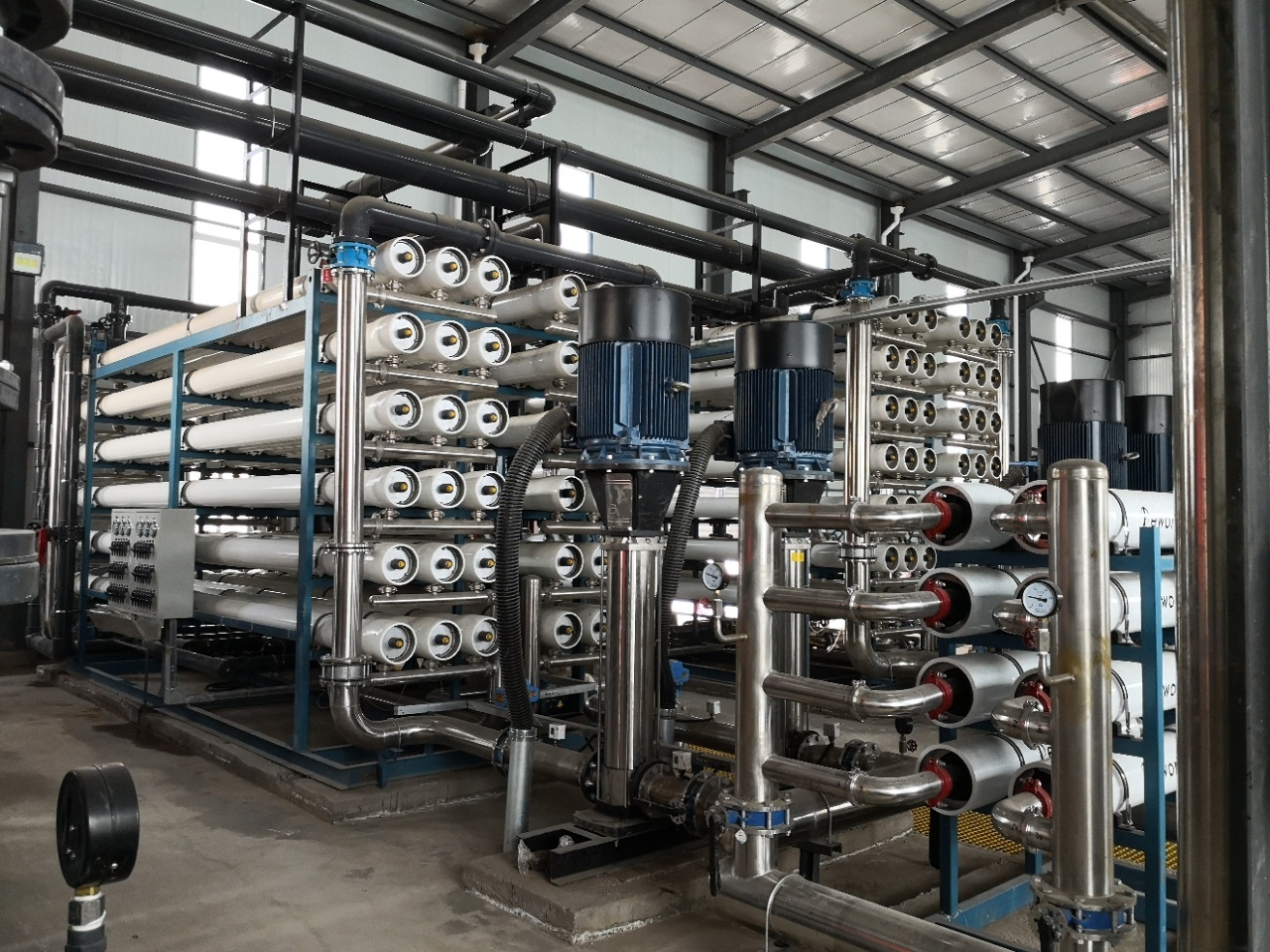
I. Reverse Osmosis Equipment Manufacturers Introduce how many years a reverse osmosis membrane element can generally be used
The service life of the membrane depends on the chemical stability of the membrane, the physical stability of the element, cleanability, influent water source, pretreatment, cleaning frequency, operation management level, etc. According to economic analysis, it is usually more than 5 years.
II. Reverse Osmosis Equipment What is the difference between it and nanofiltration?
Nanofiltration is a membrane-based liquid separation technology located between reverse osmosis and ultrafiltration. Reverse osmosis can remove small solutes with a molecular weight of less than 0.0001 microns, while nanofiltration can remove solutes with a molecular weight of around 0.001 microns. Nanofiltration is essentially a low-pressure reverse osmosis, used in situations where the purity of the treated water is not particularly strict. Nanofiltration is suitable for treating well water and surface water, and is applicable to water treatment systems that do not require the high desalination rate of reverse osmosis, but it has a high removal capacity for hardness components, sometimes called a "softening membrane". Nanofiltration systems have low operating pressure and lower energy consumption than corresponding reverse osmosis systems.
III. What is the separation capacity of membrane technology?
1. Reverse osmosis is currently a precise liquid filtration technology. Reverse osmosis membranes retain soluble salts and other inorganic molecules and organic substances with a molecular weight greater than 100. On the other hand, water molecules can freely pass through the reverse osmosis membrane. The typical removal rate of soluble salts is >95~99%, with operating pressures ranging from 7 bar (100 psi) for brackish water to 69 bar (1,000 psi) for seawater.
2. Nanofiltration can remove impurities with particles of 1 nm and organic substances with a molecular weight greater than 200~400. The removal rate of soluble solids is 20~98%, the removal rate of salts containing monovalent anions is 20~80%, while the removal rate of salts containing divalent anions is higher, at 90~98%.
3. Ultrafiltration has a separation effect on macromolecules larger than 100-1000 Å (0.01-0.1 microns). All soluble salts and small molecules can pass through the ultrafiltration membrane. Substances that can be removed include colloids, proteins, microorganisms, and macromolecular organic matter. The molecular weight cutoff of most ultrafiltration membranes is 1,000-100,000.
4. Microfiltration removes particles in the range of approximately 0.1-1 micron. Under normal circumstances, suspended solids and large-particle colloids can be retained, while macromolecules and soluble salts can freely pass through the microfiltration membrane. Microfiltration membranes are used to remove fine bacteria, microflocs, or total suspended solids (TSS). The typical pressure difference across the membrane is 1-3 bar.
Tags:
-- Recommended --


Shijiazhuang Tianwang Environmental Protection Technology Co., Ltd.
Shijiazhuang Tianwang Environmental Protection Technology Co., Ltd. is a high-tech enterprise specializing in the research and development, manufacturing and sales of water treatment equipment.
Contact Information
Production address: No. 9, Fengchan Road, Economic and Technological Development Zone, Shijiazhuang City
Office Address: 25th Floor, Block C, No. 310 Changjiang Avenue, Shijiazhuang High-tech Development Zone
Contact Number:
0311-89272359 0311-68039237
Enterprise Email:
twhbkj@163.com
Website: en.sjztwhb.com