
Softened water equipment workflow and its function
Category:
Time of issue:2020-06-22
In daily life, we often see scale forming on the inner walls of kettles after prolonged use. What is the reason for this? It turns out that the water we use contains many inorganic salts, such as calcium and magnesium salts.
These salts are invisible to the naked eye in water at room temperature. Once they are heated and boiled, many calcium and magnesium salts precipitate out as carbonates, adhering to the kettle walls to form scale. We usually use the indicator "hardness" to represent the content of calcium and magnesium ions in water. Hardness 1 is equivalent to the content of 10 milligrams of calcium oxide per liter of water. Water below 8 degrees is called soft water, and water above 17 degrees is called hard water. Water between 8 ~ 17 degrees is called moderately hard water. Rainwater, snow water, river water, lake water are all soft water, while spring water, deep well water, and seawater are all hard water.
Softener Operation Process :
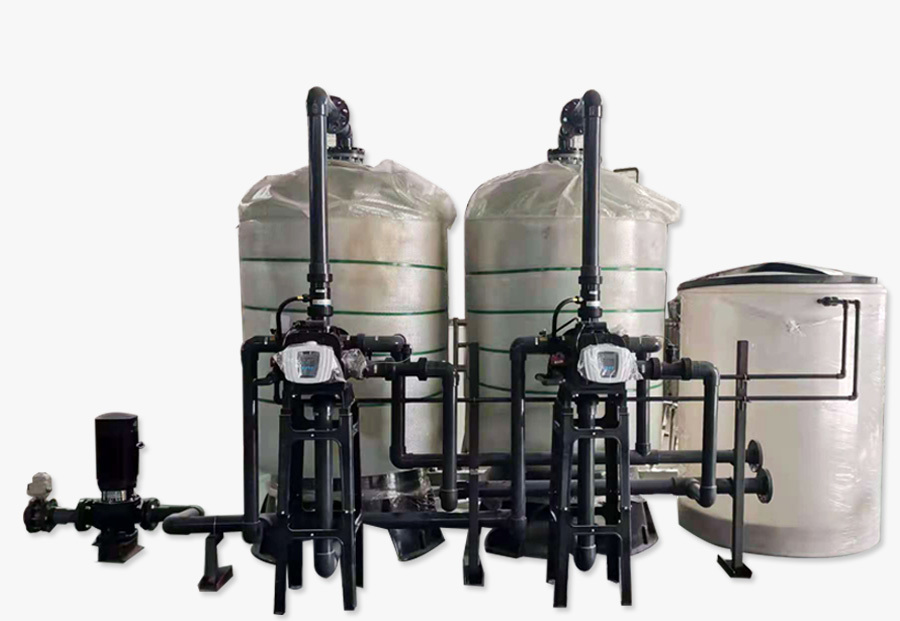
Work ( Sometimes called product water, the same below ) backwashing, salting ( regeneration ) slow rinsing ( displacement ) and fast rinsing. The procedures of different water softeners are very similar, but due to differences in the actual process or control needs, there may be some additional processes. Any water softener based on sodium ion exchange is developed on the basis of these five processes. ( Among them, fully automatic water softeners will add a brine recharge process. )。
Backwashing: After a period of operation, the equipment will intercept a lot of impurities from the raw water at the top of the resin. After removing these impurities, the ion exchange resin can be fully exposed, and the regeneration effect can be guaranteed.
The backwashing process is that water is washed in from the bottom of the resin and flows out from the top, which can flush away the impurities intercepted at the top. This process generally takes about 5-15 minutes.
Salting ( regeneration ) This is the process of injecting brine into the resin tank. Traditional equipment uses a salt pump to inject brine, while fully automatic equipment uses a special built-in injector to suck in brine. ( As long as the incoming water has a certain pressure ) . In the actual operation process, the regeneration effect of brine flowing through the resin at a slower speed is better than that of simply soaking the resin in brine, so water softeners all adopt the method of slow brine flow through the resin for regeneration. This process generally takes 30 minutes, and the actual time is affected by the amount of salt used.
Slow rinsing ( displacement ) After the brine flows through the resin, the process of slowly rinsing the salt out of the resin with raw water at the same flow rate is called slow rinsing. Since a large number of calcium and magnesium ions on the functional groups are still exchanged with sodium ions during this rinsing process, according to practical experience, this process is the main process of regeneration, so many people call this process displacement. This process generally takes the same time as salting, i.e. 30 minutes.
Fast rinsing: In order to thoroughly rinse the remaining salt, the resin should be rinsed with raw water at a flow rate close to the actual operation. The final effluent of this process should be qualified soft water. Generally, the fast rinsing process is 5-15 minutes.

The Role of Water Softening Treatment
1. The use of water softeners saves a lot of wasted fuel.
When a boiler has scale, a boiler with a working pressure of 1.4MPa will form 1 mm of scale, which will waste 8% of fuel.
2. Water softeners improve thermal efficiency and reduce output.
When there is scale on the evaporation surface of the boiler, the heat on the fire side cannot be quickly transferred to the water side, which will reduce the boiler's output. If the boiler scaling is caused by improper water treatment, the boiler's evaporation capacity is reduced by one third, and the automatic production line cannot be started due to insufficient gas supply.
3. The use of water softeners reduces boiler maintenance.
Once scale forms on the boiler plates or pipes, it is very difficult to remove, especially the leakage, cracks, breakage, deformation, and corrosion caused by scale.
Tags:
-- Recommended --


Shijiazhuang Tianwang Environmental Protection Technology Co., Ltd.
Shijiazhuang Tianwang Environmental Protection Technology Co., Ltd. is a high-tech enterprise specializing in the research and development, manufacturing and sales of water treatment equipment.
Contact Information
Production address: No. 9, Fengchan Road, Economic and Technological Development Zone, Shijiazhuang City
Office Address: 25th Floor, Block C, No. 310 Changjiang Avenue, Shijiazhuang High-tech Development Zone
Contact Number:
0311-89272359 0311-68039237
Enterprise Email:
twhbkj@163.com
Website: en.sjztwhb.com