

How to properly use a fully automatic water softener?
Category:
Time of issue:2020-06-29
For better performance of a fully automatic water softener, regular maintenance and timely servicing are crucial to extend its lifespan. Daily maintenance and upkeep are essential to ensure optimal performance of the fully automatic water softening equipment.
1. Salt Tank Usage and Maintenance
This system is equipped with a salt tank, primarily for regeneration. The tank is made of PVC or stainless steel, or other materials. For hygiene, regular cleaning is recommended for long-term use.
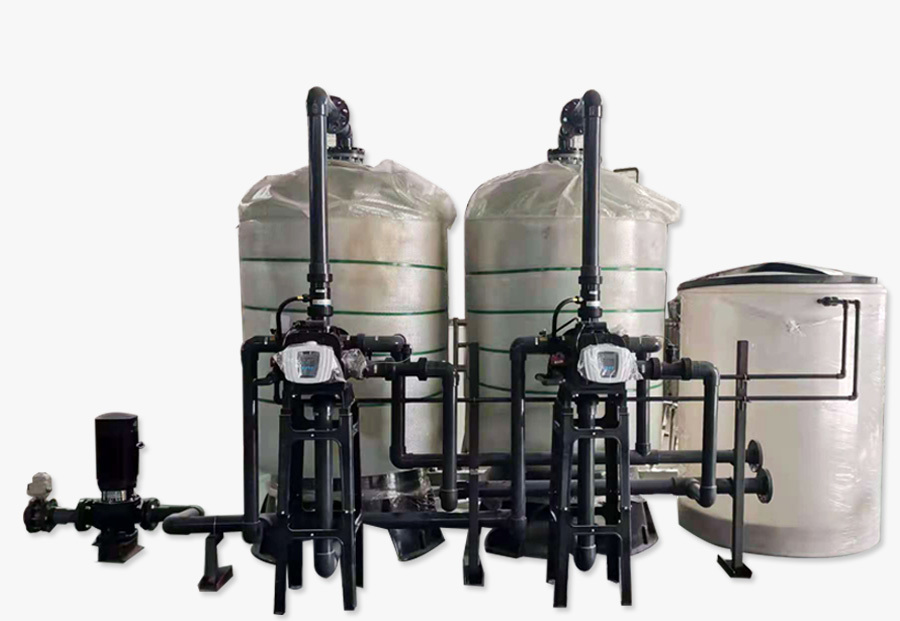
2. Softening Tank Usage and Maintenance
This is a key sealed component in the water softening process. Made of stainless steel or fiberglass, it contains a quantity of cation exchange resin. Its primary function is to reduce calcium and magnesium ions in the water when raw water passes through the resin layer via an ion exchange reaction, providing customers with industrial softened water that meets national standards.
After the fully automatic water softener operates for a period, the resin's exchange capacity becomes saturated with calcium and magnesium ions. At this point, the salt tank automatically supplies water to regenerate the ion exchange resin with brine, restoring its exchange capacity.

3. Resin Selection
The general principle for resin selection is to choose resins with high exchange capacity, high mechanical strength, uniform particle size, and good heat resistance. When selecting resin for the cation bed, choose resins with a large difference in wet true density, but they must be strong acid resins.
Pretreatment of New Resin: New resins contain excess raw materials, impurities, and incomplete reaction products. When the resin comes into contact with water, acids, alkalis, or other solutions, these impurities will enter the solution, contaminating the effluent water quality and affecting the resin's process performance and service life. Therefore, new resins must be pretreated before use.
4. How to Properly Store Ion Exchange Resin
A. Frost Protection: The resin storage environment should be above 40℃. If the temperature is below 5℃, to prevent the resin from freezing, it can be placed in a brine solution.
B. Preventing Drying: Water loss during resin use or transportation causes the resin to expand and contract, leading to breakage or reduced mechanical strength, resulting in loss or reduction of ion exchange capacity. In such cases, do not directly drop the resin into water; instead, soak it in saturated brine to allow it to slowly expand without breaking.
C. Preventing Mold: Long-term storage of ion exchange resin in the exchanger without use can lead to algae growth and bacterial reproduction, causing mold and contamination. Regular water changes and backwashing are necessary. A 1.5% formaldehyde solution can also be used for soaking.
Tags:
-- Recommended --


Shijiazhuang Tianwang Environmental Protection Technology Co., Ltd.
Shijiazhuang Tianwang Environmental Protection Technology Co., Ltd. is a high-tech enterprise specializing in the research and development, manufacturing and sales of water treatment equipment.
Contact Information
Production address: No. 9, Fengchan Road, Economic and Technological Development Zone, Shijiazhuang City
Office Address: 25th Floor, Block C, No. 310 Changjiang Avenue, Shijiazhuang High-tech Development Zone
Contact Number:
0311-89272359 0311-68039237
Enterprise Email:
twhbkj@163.com
Website: en.sjztwhb.com