

Reasons for exceeding the suspended solids standard in the secondary sedimentation tank effluent
Category:
Time of issue:2020-06-30
The appropriateness of the secondary sedimentation tank design parameters is a crucial factor in determining whether the effluent suspended solids will exceed the standard. Many municipal wastewater treatment plants, in an effort to save construction costs during the initial design phase, significantly reduce the hydraulic retention time and maximize the hydraulic surface loading rate, resulting in frequent sludge rising in the secondary sedimentation tanks during operation and exceeding the effluent suspended solids standard.
Additionally, some wastewater treatment plants, due to the need for actual process adjustments, may need to maintain a higher level of biological pool sludge concentration, which can also lead to excessive solid surface loading in the secondary sedimentation tank, affecting the effluent water quality. Therefore, it is generally believed that there should be considerable leeway in the setting of these process parameters for the secondary sedimentation tank to facilitate process control and adjustment in the wastewater treatment plant.
Generally, the main process parameters affecting the sedimentation efficiency of sedimentation tanks are hydraulic retention time, hydraulic surface loading, and sludge loading.
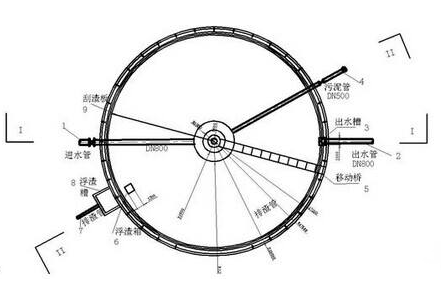
1. Hydraulic Retention Time of Secondary Sedimentation Tank
The hydraulic retention time of wastewater in the secondary sedimentation tank is an important parameter for its operation. Only with sufficient retention time can good flocculation be ensured and high sedimentation efficiency be achieved. Therefore, it is recommended that the hydraulic retention time of the secondary sedimentation tank be set at around 3-4 hours.
2. Hydraulic Surface Loading of Secondary Sedimentation Tank
For a sedimentation tank, when the influent flow rate is constant, the size of the particles that can be removed is also constant. Among these removable particles, the settling velocity of the smallest particle is equal to the hydraulic surface loading of the sedimentation tank. Therefore, the smaller the hydraulic surface loading, the more particles can be removed, the higher the sedimentation efficiency, and the lower the effluent suspended solids. Designing the secondary sedimentation tank with a smaller hydraulic surface loading is beneficial for the effective sedimentation of sludge and other suspended solids. It is generally recommended that the hydraulic surface loading of the secondary sedimentation tank be controlled at 0.6-1.2 m³/m²·h.
3. Solid Surface Loading of Secondary Sedimentation Tank
The magnitude of the solid surface loading of the secondary sedimentation tank is also an important factor affecting its sedimentation efficiency. The smaller the solid surface loading of the secondary sedimentation tank, the better the sludge concentration effect in the secondary sedimentation tank. Conversely, the sludge concentration effect is worse. Excessive solid surface loading will cause the sludge blanket to be too high, and many sludge flocs will flow out with the wastewater before they have time to settle, affecting the effluent suspended solids. Generally, the solid surface loading of the secondary sedimentation tank should not exceed 150 kg MLSS/m²·d.
4. Activated Sludge Quality
The quality of the activated sludge is an important factor affecting whether the effluent suspended solids exceed the standard. High-quality activated sludge is mainly reflected in four aspects: good adsorption performance, high biological activity, good settling performance, and good thickening performance.
Colloidal pollutants must first be adsorbed onto the activated sludge flocs and further adsorbed to the vicinity of the bacterial surface before they can be decomposed and metabolized. Therefore, activated sludge with poor adsorption performance also has poor ability to remove colloidal pollutants. The biological activity of activated sludge refers to the ability of microorganisms in the sludge flocs to decompose and metabolize organic pollutants. Activated sludge with poor biological activity will inevitably have a slower rate of removing organic pollutants.
Only activated sludge with good settling performance can achieve effective separation of mud and water in the secondary sedimentation tank. Conversely, if the sludge settling performance deteriorates, the separation effect will inevitably decrease, leading to turbid effluent from the secondary sedimentation tank, SS exceeding the standard, and in severe cases, it may also lead to significant loss of activated sludge, resulting in insufficient biomass in the system, which in turn affects the decomposition and metabolism of organic pollutants. Only when the activated sludge has good thickening performance can a higher sludge discharge concentration be obtained in the secondary sedimentation tank. Conversely, if the thickening performance is poor and the sludge discharge concentration is low, sufficient return sludge must be ensured to increase the return ratio. However, increasing the return ratio will shorten the actual retention time of wastewater in the aeration tank, leading to insufficient aeration time and affecting the treatment effect.
5. Influent SS/BOD5
The proportion of MLVSS in the activated sludge of the biological system is closely related to the influent SS/BOD5. When the influent SS/BOD5 is high, the proportion of MLVSS in the biological system activated sludge is low, and vice versa. According to operating experience, when SS/BOD is below 1, the MLVSS proportion can be maintained above 50%, while when SS/BOD5 is above 5, the VSS proportion will drop to 20-30%. When the MLVSS proportion in the activated sludge is low, in order to ensure the nitrification effect, the system must maintain a higher sludge age, and sludge aging is more obvious, leading to effluent SS exceeding the standard.
6. Toxic Substances
The presence of toxic substances such as strong acids, strong alkalis, or heavy metals in the influent wastewater will poison the activated sludge, rendering it ineffective, and in severe cases, even causing sludge disintegration, resulting in un-settleable sludge and effluent suspended solids exceeding the standard. The fundamental solution to the problem of activated sludge poisoning is to strengthen the management of upstream pollution sources.
7. Temperature
Temperature has a wide-ranging impact on the activated sludge process. First, temperature affects the activity of microorganisms in the activated sludge. In winter, when the temperature is low, if no control measures are taken, the treatment effect will decrease. Second, temperature affects the separation function of the secondary sedimentation tank. For example, temperature changes can cause density currents in the secondary sedimentation tank, leading to short-circuiting; when the temperature decreases, the viscosity of the activated sludge increases, reducing its settling performance.
Tags:
Previous
-- Recommended --


Shijiazhuang Tianwang Environmental Protection Technology Co., Ltd.
Shijiazhuang Tianwang Environmental Protection Technology Co., Ltd. is a high-tech enterprise specializing in the research and development, manufacturing and sales of water treatment equipment.
Contact Information
Production address: No. 9, Fengchan Road, Economic and Technological Development Zone, Shijiazhuang City
Office Address: 25th Floor, Block C, No. 310 Changjiang Avenue, Shijiazhuang High-tech Development Zone
Contact Number:
0311-89272359 0311-68039237
Enterprise Email:
twhbkj@163.com
Website: en.sjztwhb.com