
Detailed Explanation of Activated Carbon Filters
Category:
Time of issue:2020-07-30
Working principle
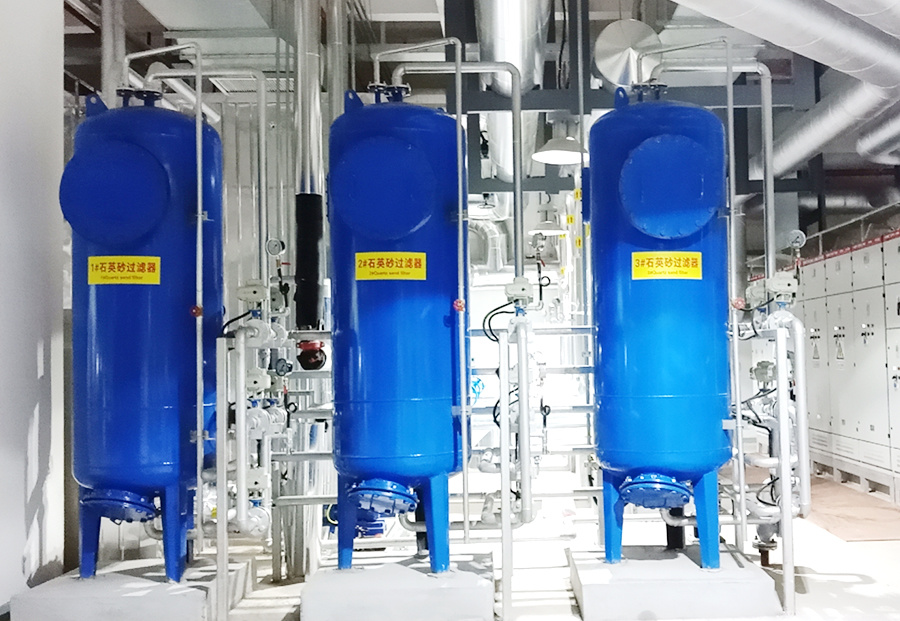
Activated carbon filters utilize granular activated carbon to further remove residual chlorine, organic matter, and suspended impurities from the water discharged by the mechanical filter, providing good conditions for subsequent reverse osmosis treatment.
1. Filtration principle of activated carbon
The adsorption capacity of activated carbon is related to water temperature and water quality. The higher the water temperature, the stronger the adsorption capacity of activated carbon; if the water temperature is above 30℃, the adsorption capacity reaches its limit and may gradually decrease. When the water quality is acidic, the adsorption capacity of activated carbon for anions is relatively weakened; when the water quality is alkaline, the adsorption capacity of activated carbon for cations is weakened. Therefore, unstable water quality pH will also affect the adsorption capacity of activated carbon.
2. Adsorption principle of activated carbon
A balanced surface concentration is formed on the surface of the particles, and then organic impurities are adsorbed into the activated carbon particles. The adsorption effect is very high in the initial stage of use. However, after a long time, the adsorption capacity of activated carbon will weaken to varying degrees, and the adsorption effect will also decrease. If the water quality in the aquarium is turbid and the organic matter content is high, the activated carbon will quickly lose its filtration function. Therefore, activated carbon should be cleaned or replaced regularly.
Operation Instructions
1. Startup preparation
A. Check whether the filter body and various valves, pipelines, instruments, and various equipment accessories are intact;
B. Check whether the flocculant dosing tank is full; whether the metering pump is intact;
C. Check whether the raw water pump, electrical equipment, various on-site instruments, and various auxiliary facilities are intact;
D. Confirm that various discharge, positive washing, and backwashing valves are closed;
E. Close the filter vent valve after seeing water.
2. Startup operation
Operation workflow:
Venting →Washing→Backwashing(II)→Forward washing→Water production→Backwashing(I)→Drainage
└—————————←—————————┘
Note: After a long period of shutdown, start from the backwashing (I) procedure.
A. Operating cycle
Open the filter inlet valve and vent valve. When the equipment is full of water, close the vent valve and open the outlet valve. When the inlet and outlet pressure difference ≥0.05~0.07Mpa, the operating cycle ends, and the equipment needs to be backwashed.
B. Backwashing time
The purpose of backwashing is to loosen the filter layer activated carbon and flush away the retained substances and broken activated carbon in the filter layer, thereby cleaning the filter layer. When backwashing, open the backwashing discharge valve and slowly open the backwashing inlet valve. The duration of backwashing is related to the amount of pollutants intercepted by the activated carbon filter layer and the backwashing flow rate. Generally, it should be determined by the turbidity of the backwashing drainage, until the drainage turbidity < 3mg/l, and no less than 20 minutes. The backwashing intensity can be used as a standard for whether the activated carbon is flushed out.
C. Forward washing time
Open the inlet valve and forward washing discharge valve. The time is set according to the forward washing until the drainage pollution index ≤4, residual chlorine ≤0.1ppm, and no less than 30 minutes.

Maintenance
1. Inspection during installation preparation
The equipment and accessories have undergone strict quality inspection at our company and have been shipped after passing the inspection. Therefore, unnecessary disassembly and opening of the assembled equipment and accessories are not performed. However, the shipping list should be carefully checked. Check and inspect the goods to ensure that the installation process proceeds smoothly. If any paint or rust layer is damaged during transportation or unpacking, necessary repairs should be made. During installation, no welding or gas cutting operations are allowed on the surface of the equipment body to ensure that the internal rubber lining is not burned.
2. Inspection during commissioning preparation
After the installation, piping, and instrumentation engineering are completed, and after the cleaning of the equipment body and piping, the following inspection items should be checked and maintained.

3. Inspection during commissioning and debugging
After the inspection in the preparation stage, in addition to the required commissioning, the following items must also be checked.

4. Daily operation inspection
After commissioning and debugging enter normal production, the operators should regularly patrol and inspect the equipment site every day. The results of the patrol inspection should be truthfully recorded and summarized together with the operation records as data for regular maintenance.

5. Regular inspection
After one year of normal production, the equipment should undergo a regular inspection to ensure safe operation without accidents within the second year.
In order to shorten the shutdown time for regular inspections, as long as the number of inspectors and maintenance workers permits, it should be carried out simultaneously with the inspection of other equipment and devices at the water station. If any abnormalities are found during the inspection, they must be dealt with and resolved in time.

Tags:
-- Recommended --


Shijiazhuang Tianwang Environmental Protection Technology Co., Ltd.
Shijiazhuang Tianwang Environmental Protection Technology Co., Ltd. is a high-tech enterprise specializing in the research and development, manufacturing and sales of water treatment equipment.
Contact Information
Production address: No. 9, Fengchan Road, Economic and Technological Development Zone, Shijiazhuang City
Office Address: 25th Floor, Block C, No. 310 Changjiang Avenue, Shijiazhuang High-tech Development Zone
Contact Number:
0311-89272359 0311-68039237
Enterprise Email:
twhbkj@163.com
Website: en.sjztwhb.com