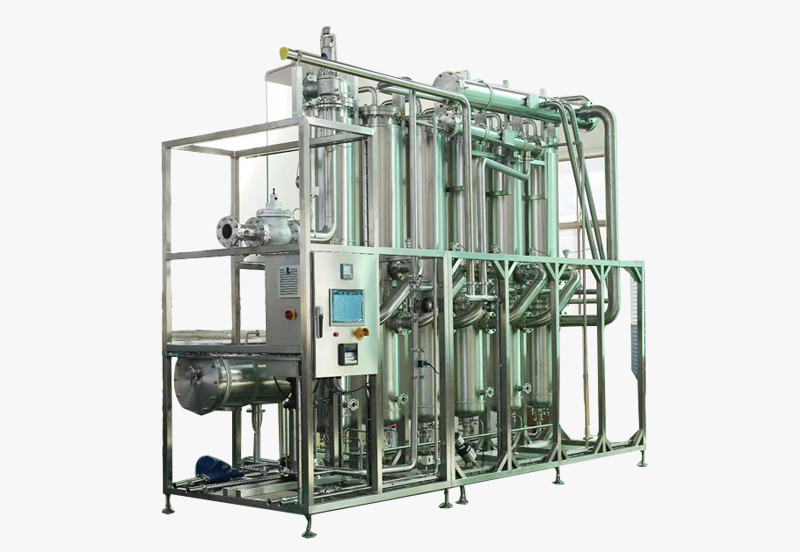
Do you know the advantages of these EDI water treatment devices?
Category:
Time of issue:2020-09-25

Advantages of EDI Water Treatment Equipment
Continuous Electrodialysis (EDI) Electrodeionization or CDI, Continuous Electrode ionization) uses mild ion exchange resin to adsorb anions and cations in the feed water. Under the action of DC voltage, these adsorbed ions pass through anion and cation exchange membranes and are removed. This process does not require acid and alkali regeneration of ion exchange resin. This new technology can replace traditional ion exchange (DI) devices to produce ultrapure water with a resistance as high as 18 MΩ•cm. EDI ultrapure water equipment is used after the reverse osmosis system to replace the traditional mixed bed ion exchange technology to produce stable ultrapure water. Compared with mixed ion exchange technology, EDI technology has the following advantages:
1. Stable water quality
2. Easy to achieve fully automatic control
3. No shutdown due to regeneration
4. No chemical regeneration required
5. Low operating cost
6. Small plant area
7. No wastewater discharge
Working Process of EDI Water Treatment Equipment
Generally, natural waters contain dissolved substances such as sodium, calcium, magnesium, chlorides, salts, and bicarbonates. These compounds are composed of negatively charged anions and positively charged cations. Through reverse osmosis (RO) treatment, more than 95%-99% of ions can be removed. The resistivity of RO pure water (EDI feed water) generally ranges from 0.05-1.0 MΩ•cm, i.e., the conductivity range is 20-1 μS/cm. Depending on the situation, the resistivity of deionized water generally ranges from 5-18 MΩ•cm. In addition, the original water may also contain other trace elements, dissolved gases (such as CO2) and some weak electrolytes (such as boron, silicon dioxide). These impurities must be removed in industrial desalination water. However, the reverse osmosis process has a poor removal effect on these impurities. Therefore, the role of EDI is to increase the resistivity of water from 0.05-1.0 MΩ•cm to 5-18 MΩ•cm by removing electrolytes (including weak dielectrics). The working principle of ion exchange membrane and ion exchange resin is similar, and ions can be selectively passed through. Among them, the anion exchange membrane only allows anions to pass through and does not allow cations to pass through; while the cation exchange membrane only allows cations to pass through and does not allow anions to pass through. Filling the space between a pair of anion and cation exchange membranes with mixed ion exchange resin forms an EDI unit. The space between the anion and cation exchange membranes occupied by the mixed ion exchange resin is called the freshwater chamber. A certain number of EDI units are arranged together, so that the anion exchange and cation exchange membranes are arranged alternately, and special ion exchange resin is added between the ion exchange membranes, and the space formed is called the concentrate chamber. Under the action of a given DC voltage, in the freshwater chamber, the anions and cations in the ion exchange resin migrate to the positive and negative electrodes respectively, and pass through the anion and cation exchange membranes into the concentrate chamber, while the ions in the feed water are adsorbed by the ion exchange resin and occupy the vacancies left by ion electromigration. In fact, ion migration and adsorption occur simultaneously. Through this process, the ions in the feed water pass through the ion exchange membrane into the concentrate chamber to be removed and become desalted water.
Negatively charged anions (such as OH-, Cl-) are attracted by the positive electrode (+) and pass through the anion exchange membrane into the adjacent concentrate chamber. After that, these ions continue to migrate to the positive electrode and encounter the adjacent cation exchange membrane, and the cation exchange membrane does not allow anions to pass through, so these ions are blocked in the concentrate water. Cations (such as Na+, H+) in the freshwater stream are blocked in the concentrate chamber in a similar way. In the concentrate chamber, the ions passing through the anion and cation membranes maintain electrical neutrality. The current of the EDI component is proportional to the amount of ion migration. The current consists of two parts: one is from the migration of the removed ions, and the other is from the migration of H+ and OH- ions produced by the ionization of water itself.
There is a high voltage gradient in the EDI component, under which water will electrolyze to produce a large amount of H+ and OH-. These locally produced H+ and OH- ions have a continuous regeneration effect on the ion exchange resin. The ion exchange resin in the EDI component can be divided into two parts: one is called the working resin, and the other is called the polishing resin. The boundary between the two is called the working front. The working resin is responsible for removing most of the ions, while the polishing resin is responsible for removing weak electrolytes and other difficult-to-remove ions.
Pretreatment of EDI feed water is a prerequisite for EDI to achieve its optimal performance and reduce equipment failures. Impurities in the feed water will have a negative impact on the performance components, increase maintenance and reduce the life of the membrane components. 和OH-离子的迁移。
在EDI组件中存在较高的电压梯度,在其作用下,水会电解产生大量的H+和OH-。这些就地产生的H+和OH-离子交换树脂有连续再生的作用。
EDI组件中的离子交换树脂可以分为两部分,一部分称作工作树脂,另一部分称作抛光树脂,二者的界限称为工作前沿。工作述职承担着除去大部分离子的任务,而抛光树脂则承担着去除弱电解质等较难清除离子的任务。
EDI给水的预处理是EDI实现其最优性能和减少设备故障的首要前提条件。给水里的污染物会对出演组件有负面影响,增加维护量并降低膜组件的寿命。
Tags:
-- Recommended --


Shijiazhuang Tianwang Environmental Protection Technology Co., Ltd.
Shijiazhuang Tianwang Environmental Protection Technology Co., Ltd. is a high-tech enterprise specializing in the research and development, manufacturing and sales of water treatment equipment.
Contact Information
Production address: No. 9, Fengchan Road, Economic and Technological Development Zone, Shijiazhuang City
Office Address: 25th Floor, Block C, No. 310 Changjiang Avenue, Shijiazhuang High-tech Development Zone
Contact Number:
0311-89272359 0311-68039237
Enterprise Email:
twhbkj@163.com
Website: en.sjztwhb.com