
Introduction to Reverse Osmosis Water Treatment Equipment
Category:
Time of issue:2020-11-02

I. Preparation Principle
Reverse osmosis water treatment equipment typically consists of three parts: a raw water pretreatment system, a reverse osmosis purification system, and an ultrapurification post-treatment system. The purpose of pretreatment is mainly to ensure that the raw water meets the inlet water requirements of the reverse osmosis membrane separation components and to guarantee the stable operation of the reverse osmosis purification system. The reverse osmosis membrane system is the most economical and efficient purification method for removing more than 98% of ions and organic matter and 100% of microorganisms (theoretically) from raw water in a single step. The ultrapurification post-treatment system further removes trace ions, organic matter, and other impurities remaining in the reverse osmosis purified water through a variety of integrated technologies to meet the final water quality requirements for different applications.
II. Working Principle
Reverse osmosis is the most precise membrane-based liquid separation technology. Operating pressure is applied to the feed water (concentrated solution) side to overcome the natural osmotic pressure. When an operating pressure higher than the natural osmotic pressure is applied to the concentrated solution side, the natural permeation direction of water molecules is reversed, and some of the water molecules in the feed water (concentrated solution) pass through the reverse osmosis membrane to become purified water on the dilute solution side; reverse osmosis equipment can block all dissolved salts and organic substances with a molecular weight greater than 100, but allows water molecules to pass through. The desalination rate of reverse osmosis composite membranes is generally greater than 98%. They are widely used in the preparation of industrial pure water and electronic ultrapure water, the production of drinking purified water, boiler feed water, etc. Using reverse osmosis equipment before ion exchange can significantly reduce the amount of operating water and wastewater discharge.
III. Pretreatment System Introduction
Reverse osmosis water treatment systems generally include a pretreatment system, a reverse osmosis unit, a post-treatment system, a cleaning system, and an electrical control system.
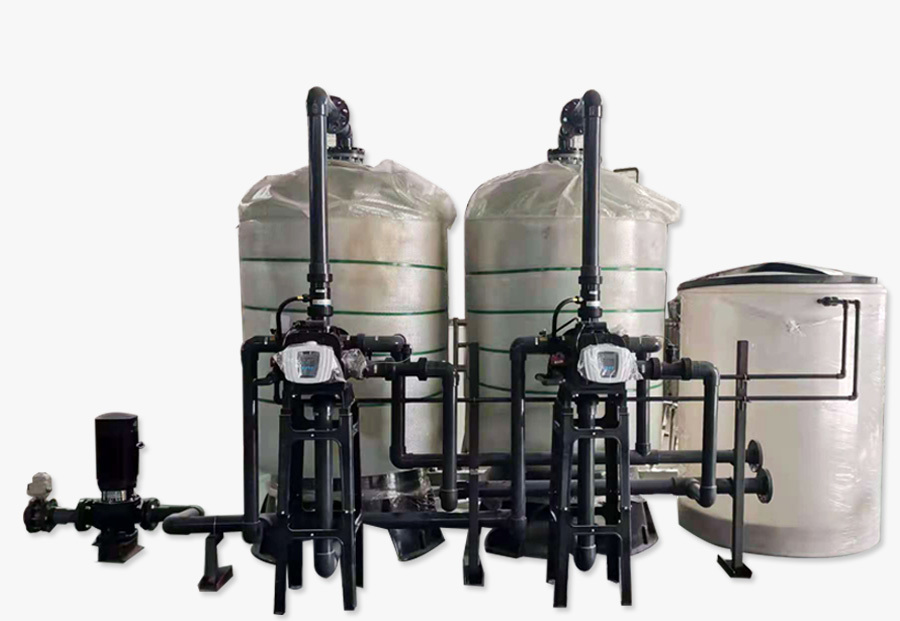
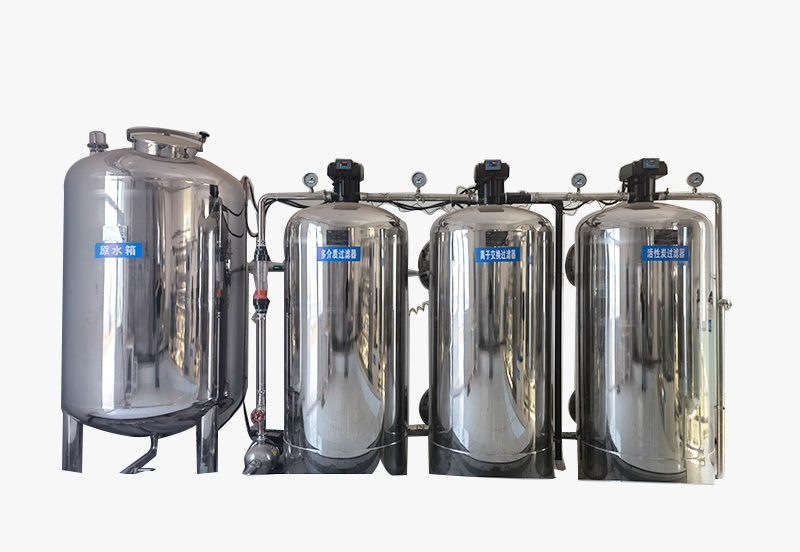
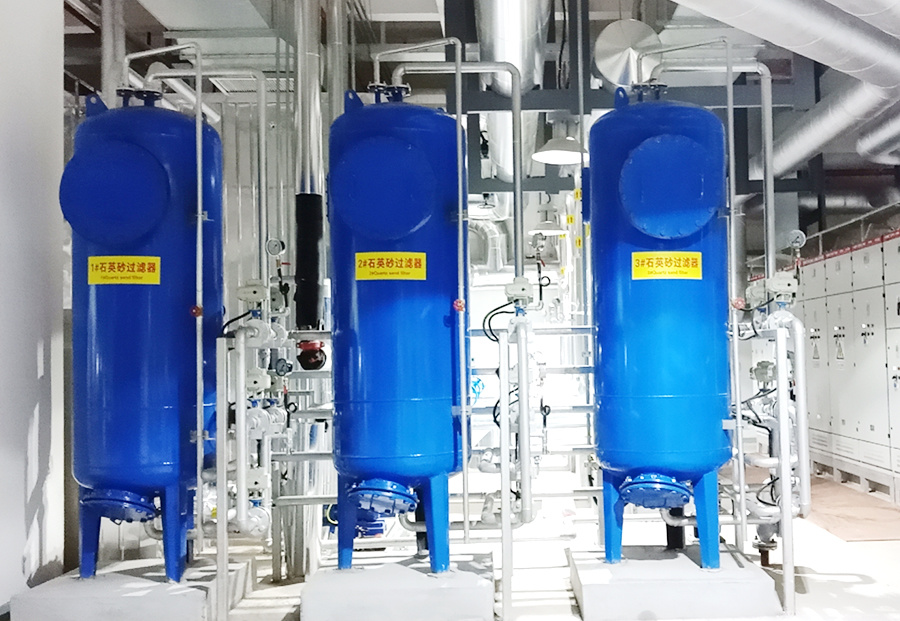
The pretreatment system generally includes quartz sand filters, activated carbon filters, and precision filters. Its main function is to reduce the pollution index and residual chlorine and other impurities in the raw water to meet the inlet water requirements of reverse osmosis.
Detailed Classification of the Pretreatment System:
1. Quartz Sand Filter
Quartz sand filters mainly remove suspended matter, colloids, mud, clay, humus, and particulate matter from the water. This reduces water turbidity, clarifies the water, and protects the reverse osmosis membrane.
2. Activated Carbon Filter
Activated carbon filters mainly utilize the large number of hydroxyl groups and other functional groups on the surface of activated carbon to chemically adsorb various substances, removing odors, organic matter, colloids, iron, and residual chlorine from the water, while also reducing water color and turbidity, and reducing pollution to the reverse osmosis system.
3. Softener
Using the sodium ions on the ion exchange resin to exchange the calcium and magnesium ions in the water, reducing water hardness, and simultaneously regenerating the ion exchange resin with softening salt. Softening salt is also known as an ion exchange resin regenerant.
4. Precision Filter
Using a 5-micron PP melt-blown filter element, it mainly removes particles larger than 5 microns that were not completely removed by the pretreatment system, retaining filter material lost in the previous three filtration processes, thereby protecting the RO membrane.
Whether the filter element can meet normal operating conditions will affect the normal operating conditions of the membrane. Generally, the filter element should be replaced every 3-4 months.
IV. Reverse Osmosis System Introduction
The reverse osmosis system mainly includes a multi-stage high-pressure pump, reverse osmosis membrane elements, membrane shells (pressure vessels), and supports. Its main function is to remove impurities from the water to meet the requirements of use.
The high-pressure pump increases the pressure of the water from the security filter to the operating pressure of the RO, and then evenly distributes it to the pressure vessels. The water flow is separated by the reverse osmosis membrane and forms two water streams in the pressure vessel. Part of the feed water passes through the membrane to form purified water, while the remaining inorganic salts and solid residues are retained and concentrated to form concentrated water, thus achieving the separation of inorganic salts and water. The purified water flows out of each pressure vessel containing the reverse osmosis membrane elements, and after converging, it flows through the flow meter and then out of the equipment outlet into the pure water tank. The concentrated water flows out from the concentrated water outlet of the pressure vessel.
Reverse osmosis membrane desalination mechanism: Many extremely fine membrane pores are distributed on the epidermis of the semi-permeable membrane. The surface of the membrane selectively adsorbs a layer of water molecules, while salt solutes are repelled by the membrane. Ions with higher valence states are repelled further. Under the driving force of reverse osmosis pressure, the water molecules around the membrane pores flow out as pure water through capillary action, achieving desalination. When the membrane pores are larger than the reverse osmosis membrane pore range, the salt solution will leak through the membrane, with more monovalent salts leaking, followed by divalent salts, and even less trivalent salts.
The pore size of the RO membrane is <1.0 nm, so the RO membrane can filter out at least Pseudomonas aeruginosa (3000 × 10-10 m); it can also filter out various viruses, such as influenza virus (800 × 10-10 m), meningitis virus (200 × 10-10 m); and even pyrogens (10-500 × 10-10 m).
The characteristics of preparing pure water using reverse osmosis are as follows: :
Compact equipment structure, easy maintenance, small footprint, and high water production.
Pure water is prepared without phase change, resulting in low energy consumption.
There is no discharge of acid or alkali wastewater, making it a new type of energy-saving and environmentally friendly equipment.
This advanced membrane separation technology is widely used in various fields. 。
V. Reverse Osmosis System Maintenance
1. Conduct daily water quality testing and record equipment operating parameters. Address any abnormalities promptly. Regularly check and record important parameters such as pure water conductivity, pressure at various points, and inlet and outlet water flow.
2. Regularly add regenerant to the salt tank. Set the regeneration time based on actual site conditions and water production. Generally, add once every 3-4 days.
3. Replace the security filter element in a timely manner (generally replaced every 3-6 months).
4. Regularly wipe the machine to keep the equipment clean.
5. Regularly check the pipelines for leaks and resolve them promptly.
6. Ensure the equipment has a normal water and power supply. If there is a power or water outage, the equipment needs to be readjusted, especially the regeneration time after a power outage needs to be reset. Unauthorized personnel are prohibited from touching the buttons on the electrical control part and the valves on the pipeline part to prevent misoperation and malfunction of the equipment.
VI. Emergency Measures
If the equipment is powered off or the main pump, membrane, or other components that produce pure water are damaged and cannot produce pure water, the softened water valve can be opened to continue using softened water to ensure the normal operation of the water-using equipment. This method should be based on the actual requirements of the water-using equipment.
1. If the equipment leaks severely, immediately turn off the equipment's water inlet switch and power, and notify the service provider.
2. During the water production process, if the post-membrane pressure gauge shows more than 1.5Mpa, the conductivity exceeds 15us/cm, or the water quality exceeds the standard range, the resin, membrane, activated carbon, and other consumables should be replaced in time.
VII. Consumable Replacement Instructions
Since consumables such as quartz sand, activated carbon, and softening resin are granular substances, accumulation easily forms a porous structure, providing a growth environment for long-term bacterial reproduction. At the same time, activated carbon and softening resin have a certain degree of adsorption saturation. After long-term use, the filtration effect decreases. When backwashing and regeneration cannot meet the pretreatment effect, replacement can be carried out to ensure the water quality of the reverse osmosis membrane.
Under all conditions, the service life of quartz sand is 10-24 months, the service life of activated carbon is 10-12 months, the service life of resin is 10-12 months, the service life of precision filter element is 3-6 months, and the service life of reverse osmosis membrane is about 12 months.
Resin regeneration cycle: Under normal conditions, the resin regeneration cycle is 1-3 days.
VIII. Application Areas
1. Power industry: boiler feed water, cooling water dam;
2. Electronics industry: ultrapure water for the semiconductor industry, cleaning water for integrated circuits, formula water;
3. Food industry: formula water, production water;
4. Pharmaceutical industry: process water, preparation water, washing water, injection water, sterile water preparation;
5. Beverage industry: formula water, production water, washing water;
6. Chemical industry: production water, wastewater treatment;
7. Drinking water projects: ultrapure water preparation, drinking water purification;
8. Petrochemical industry: oilfield injection water, deep treatment of petrochemical wastewater;
9. Seawater desalination: production and living water in island areas, coastal water-scarce areas, ships, and offshore oil fields;
10. Environmental protection field: recovery of precious metals and water in electroplating rinsing water, achieving zero emission or micro-emission.
Tags:
-- Recommended --


Shijiazhuang Tianwang Environmental Protection Technology Co., Ltd.
Shijiazhuang Tianwang Environmental Protection Technology Co., Ltd. is a high-tech enterprise specializing in the research and development, manufacturing and sales of water treatment equipment.
Contact Information
Production address: No. 9, Fengchan Road, Economic and Technological Development Zone, Shijiazhuang City
Office Address: 25th Floor, Block C, No. 310 Changjiang Avenue, Shijiazhuang High-tech Development Zone
Contact Number:
0311-89272359 0311-68039237
Enterprise Email:
twhbkj@163.com
Website: en.sjztwhb.com