
How does water softening equipment soften water
Category:
Time of issue:2020-11-19
How water softeners soften water:
Water softening treatment technology is widely used in various fields of industrial and agricultural production and life in China. Industrial boilers alone account for nearly 500,000 units in China. However, reliable statistics from relevant departments in recent years have revealed a distressing result: accidents caused by poor water quality account for 50% of boiler accidents and are on the rise. Comprehensive analysis shows that one reason is the low skill level of operators, resulting in the long-term incorrect or uneconomical operation of water softening equipment. Efforts to improve the quality of operators often yield little results, consuming time and effort without solving the fundamental problem. Therefore, the most fundamental solution lies in finding a simple and easy-to-use water softening device.

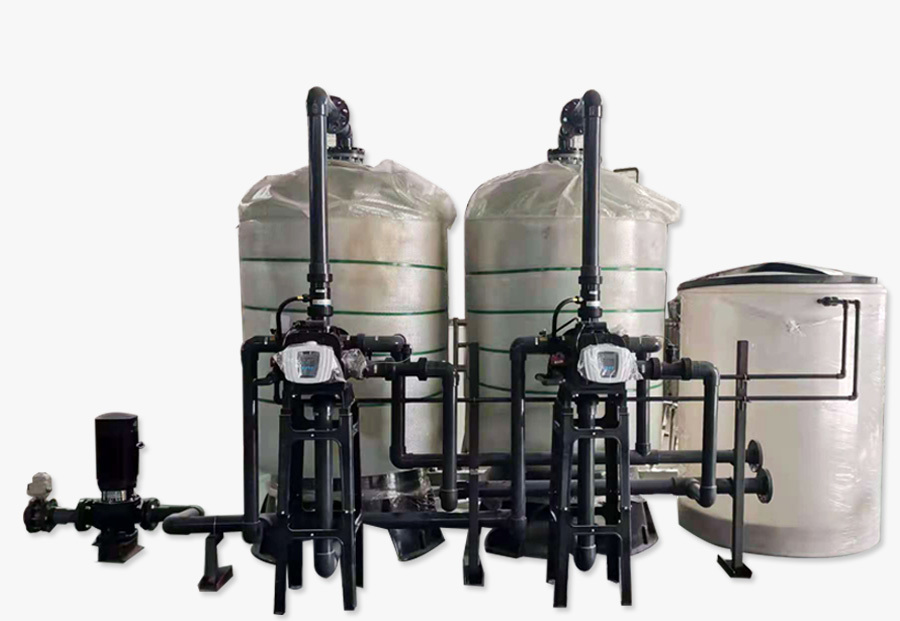
Working Principle of Water Softening Equipment
Water softening equipment is specifically designed to remove calcium and magnesium ions from water, with an efficiency as high as 99%. It can also remove algae and suspended solids from water, making the treated water soft and clear.
When raw water containing hardness ions passes through the resin layer inside the water softener, the calcium and magnesium ions in the water are exchanged and adsorbed by the resin, while an equal amount of sodium ions is released. The water flowing out of the water softener is softened water with hardness ions removed.
The exchange process is as follows:
2RNa + Ca2+ = R2Ca + 2Na+
2RNa + Mg2+ = R2Mg + 2Na+
That is, after passing through the sodium ion exchanger, the Ca+ and Mg+ in the water are replaced with Na+.
When the sodium ion exchange resin fails, regeneration treatment is required to restore its exchange capacity. The regenerant is a readily available and inexpensive sodium chloride solution.
The regeneration process is as follows:
R2Ca + 2NaCl = 2RNa + CaCl2
R2Mg + 2NaCl = 2RNa + MgCl2
Through the above treatment, the regeneration process involves using the brine from the salt tank to rinse the resin layer, replacing the hardness ions on the resin and discharging them with the regeneration waste liquid. The resin then recovers its softening exchange capacity.
When water flows through the resin layer, the ion exchange resin releases sodium ions, and the functional groups bind with calcium and magnesium ions, thus reducing the content of calcium and magnesium ions in the water and decreasing the water hardness. Hard water becomes soft water; this is the working process of the water softening equipment.
When a large number of functional groups on the resin bind with calcium and magnesium ions, the softening capacity of the resin decreases. Sodium chloride can be passed through the resin. At this time, the solution has a high sodium ion content, and the functional groups will release these ions and bind with sodium ions, thus restoring the exchange capacity of the resin. This process is called "regeneration".
II. Working Process of Water Softening Equipment
Due to practical needs, the standard working process of water softening equipment mainly includes five processes: water production, backwashing, salting, rinsing, and salt tank water injection.
1. Backwashing: This has two main functions: firstly, it loosens the resin layer to allow the brine to fully contact the resin layer, making the conversion reaction more thorough; secondly, it washes away the suspended matter intercepted by the resin. This process generally takes about 5-15 minutes.
2. Salting: This is the process of injecting brine into the resin tank. Traditional equipment uses a salt pump to inject brine, while fully automatic equipment uses a dedicated built-in injector to draw in brine. In actual operation, brine flowing slowly through the resin produces better regeneration results than simply soaking the resin in brine. Therefore, water softening equipment uses the method of slowly flowing brine through the resin for regeneration. This process generally takes about 60 minutes, and the actual time is affected by the amount of salt used.
3. Rinsing: To thoroughly rinse away the residual salt, a flow rate close to the actual working flow rate is required to rinse the resin with raw water. The final effluent of this process should be qualified softened water. Generally, the fast rinsing process takes 5-15 minutes.
Tags:
-- Recommended --


Shijiazhuang Tianwang Environmental Protection Technology Co., Ltd.
Shijiazhuang Tianwang Environmental Protection Technology Co., Ltd. is a high-tech enterprise specializing in the research and development, manufacturing and sales of water treatment equipment.
Contact Information
Production address: No. 9, Fengchan Road, Economic and Technological Development Zone, Shijiazhuang City
Office Address: 25th Floor, Block C, No. 310 Changjiang Avenue, Shijiazhuang High-tech Development Zone
Contact Number:
0311-89272359 0311-68039237
Enterprise Email:
twhbkj@163.com
Website: en.sjztwhb.com