

Technical indicators and design points for installing water softening treatment
Category:
Time of issue:2020-12-04
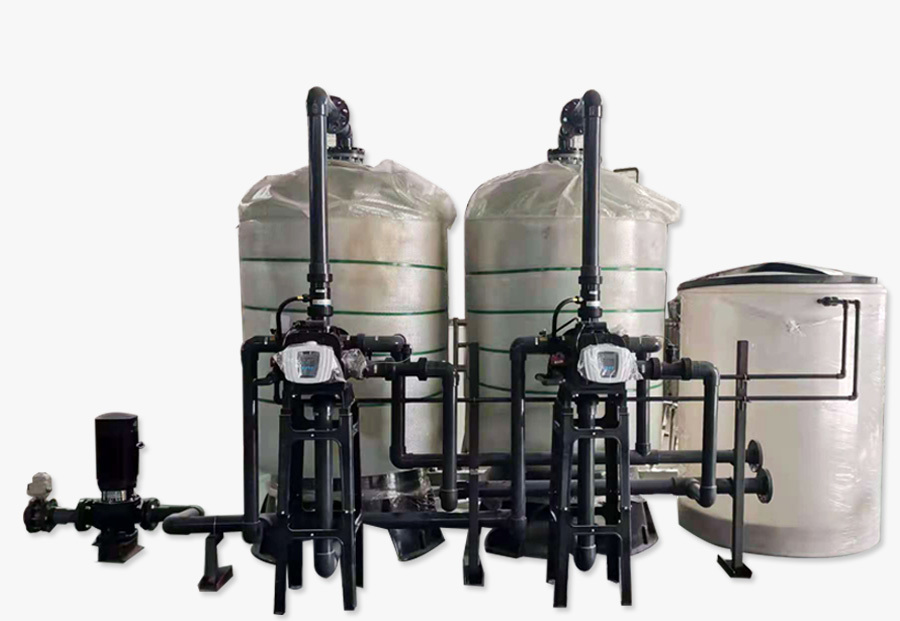
1. Water Softening Equipment Regarding the selection and setup of water softening equipment: The water softener must be placed on a firm, level surface. It should be as close as possible to the drain, but at least 3 meters away from heat sources such as boilers. Water softening equipment must never be placed near acidic liquids or gases. If other water treatment equipment (filters, deaerators) needs to be added, space should be reserved.

2. Water Softening Equipment Regarding the location of the regeneration salt tank and water softening resin:
They should be placed as close as possible to the exchange column. To fully utilize the brine, the length of the salt-sucking plastic pipe should be minimized.
3. Water Softening Equipment Regarding the filling of quartz sand and resin:
(1) Water Softening Equipment Ensure even water replenishment. Approximately 150-200mm of high-quality quartz sand (which does not decompose to produce silicon oxides or salts) should be laid at the bottom of the exchange column.
(2) Water Softening Equipment Before filling the resin, check the length of the central lifting pipe to ensure it is appropriate.
Water Softening Equipment First, insert the upper water distributor into the central interface at the bottom of the automatic control head (control valve). Then, align the lower end of the central pipe with the recess at the bottom of the exchange column, and insert the upper end into the lower end of the upper water distributor. Carefully rotate clockwise into the threaded opening at the top of the exchange column. Ensure that the entire control valve threaded opening can be smoothly screwed into the top threaded opening of the exchange column to confirm that the length of the central pipe meets the requirements and that the central lifting pipe is tightly connected to the valve head and remains concentric.
(3) After the above test fitting of the control head is complete, rotate the head counterclockwise to remove it. Maintain the central position of the central pipe. Align the lower end of the lower water distributor (originally glued to the bottom of the central lifting pipe) with the recess at the bottom, and seal the upper inlet of the central lifting pipe with a soft cloth or plastic strip. Begin evenly filling the quartz sand or resin.
(4) When filling the resin, ensure even filling around the central lifting pipe. To ensure that the pre-calculated quantity is fully loaded into the column, continuously inject clean water into the exchange column during the filling process to expel air from the resin pores. Maintaining this water-sealed state during resin filling is the best method. Dry resin makes it difficult to guarantee the correct amount of filling.
(5) After the resin is filled, re-insert the control valve clockwise into the threaded opening at the top of the exchange column.
With technological advancements and increasing national emphasis on environmental protection, the demand for various new types of boilers is growing, along with higher requirements for boiler feedwater equipment. The equipment must meet water quality requirements while maintaining stable and reliable operation with a high degree of automation.
I. Equipment Technical Specifications
1. Raw water hardness <12 m.mol/L (If raw water hardness >8 m·mol/L, please declare in advance)
2. Treated water hardness <0.03 m·mol/L (Meets the requirements of GB1576-2001, National Standard for Low-Pressure Boiler Water Quality)
3. Operating water pressure 0.20-0.5 MPa
4. Operating voltage ~220V, 50Hz
5. Operating temperature 0~50℃
6. Raw water turbidity <5 degrees (If the raw water contains a high sand content, a filter should be installed)
7. Salt consumption <100 g/N (Related to raw water hardness)
8. Water consumption ~2%
9. Power consumption <30W
II. Water Softening Equipment Design and Selection Guide
1. Water Softening Equipment Selection
The selection of water softening equipment is mainly based on water demand, raw water hardness, and application scenarios.
(1) There are various models with the same water output; select according to the actual water usage.
(2) Raw water hardness: Shenlan boiler water softener, Shenlan fully automatic water softener, water softening treatment equipment
Raw water hardness ≤3 m·mol/L, time control type can be selected, calculated according to the maximum water output of the equipment;
Raw water hardness ≤6 m·mol/L, can be selected according to the maximum water output capacity of the equipment in the table;
Raw water hardness ≤8 m·mol/L, can be selected according to the average water output capacity of the equipment;
Raw water hardness 8~10 m·mol/L, should be calculated according to the minimum water output capacity of the equipment, or a multi-stage system should be used;
Raw water hardness ≥10 m·mol/L, a multi-stage treatment should be used; generally, two-stage treatment can meet the requirements.
(3) Water usage scenarios: If used with a hot water boiler or other similar equipment, select according to the highest water output capacity of the equipment; if supplying water to a steam boiler, generally match it with the boiler evaporation capacity multiplied by 1.2.
2. Water Softening Equipment Design and Installation Points
The equipment itself has a simple structure and small footprint, so there are no special requirements for design and installation. Only the following points need to be considered during design and installation:
(1) The equipment requires a simple level base; approximately 250-450mm from the wall, it can be arranged at the corner according to the actual situation;
(2) Because the equipment itself is relatively light, generally only the weight of the resin and water installed in the equipment needs to be considered;
Inlet and outlet pipes shall be connected with standard flanges or threads, and shall be fixed and supported well. They shall not rely on the valve body for support to prevent stress;
A water pressure gauge shall be installed on the inlet pipe. When the equipment is running and flushing water is discharged, a floor drain or drainage ditch shall be set nearby.
Brine pipe: The brine tank should be as close as possible to the softener tank, and the brine pipe should be as short as possible;
The drain pipe should not be longer than 6 meters, no stop valve should be installed, the outlet should not be higher than the valve body, the terminal should be open to prevent siphonage, and the number of elbows should be as few as possible;
Install a power outlet on the wall near the equipment. It should be equipped with a fuse (generally no switch should be installed), and good grounding is required.
Tags:
-- Recommended --


Shijiazhuang Tianwang Environmental Protection Technology Co., Ltd.
Shijiazhuang Tianwang Environmental Protection Technology Co., Ltd. is a high-tech enterprise specializing in the research and development, manufacturing and sales of water treatment equipment.
Contact Information
Production address: No. 9, Fengchan Road, Economic and Technological Development Zone, Shijiazhuang City
Office Address: 25th Floor, Block C, No. 310 Changjiang Avenue, Shijiazhuang High-tech Development Zone
Contact Number:
0311-89272359 0311-68039237
Enterprise Email:
twhbkj@163.com
Website: en.sjztwhb.com