
Q&A about water treatment
Category:
Time of issue:2021-01-04
I. Several basic concepts in water treatment systems: TDS, SDI, LSI, KSP.
Answer: TDS: Total Dissolved Solids (generally similar to mineralization)
SDI: Silt Density Index is an indicator to measure the pretreatment effect of the system. For SDI < 6.7, for well water, the reverse osmosis device requires SDI < 5 for influent water.
LSI: Langelier Saturation Index, Langelier index is used to measure the scaling tendency of the reverse osmosis device. LSI = 0, the system has no scaling or corrosion tendency; LSI > 0, the system has a scaling tendency; LSI < 0, the system has a corrosion tendency. For reverse osmosis systems, the LSI value should not be greater than 0. The LSI value of the system can be reduced by adding acid or reducing the water recovery rate.
Ksp: Solubility product constant. Reverse osmosis devices selectively permeate solvents and solutes in raw water. Due to the reduction of solvent on the concentrate side, concentration occurs. When the concentration product of dissolved solids on the concentrate side exceeds the solubility product constant, crystallization will occur, which will harm the reverse osmosis device. The solubility product constant of the system can be increased by adding scale inhibitors. Scale inhibitors can increase the solubility of dissolved solids.

II. How can the LSI index be effectively controlled?
Answer: The LSI index of the system can be effectively controlled through the following aspects:
1. The system LSI index can be reduced by reducing the system water recovery rate.
2. The system LSI index can be reduced by adding acid.
3. The solubility of dissolved salts in the system can be increased by adding corresponding reagents, such as adding TRISPE1000 scale inhibitor.
4. Ions that are easy to form structures in water can be reduced or pre-removed, such as softening the system influent water through a softener.
III. What pretreatment equipment do you know?
Answer: Pretreatment equipment includes: mechanical filter, high-efficiency fiber filter, activated carbon filter, precision filter, ultrafiltration, microfiltration, sodium ion softener, iron and manganese removal filter, dosing device, raw water tank, aeration tank.
IV. What desalination pretreatment equipment do you know?
Answer: Desalination pretreatment equipment includes electrodialysis devices and reverse osmosis devices.
V. What deep desalination equipment do you know?
Answer: Deep desalination equipment includes anion exchangers, cation exchangers, mixed ion exchangers, distillation devices, and EDI devices.
VI. How is a mechanical filter selected? What is its working principle?
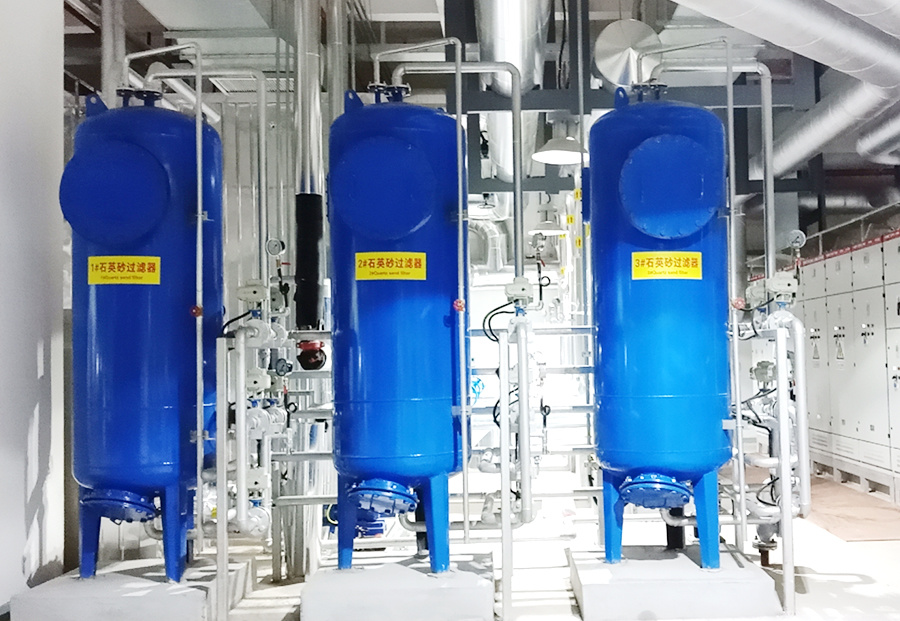
Answer: The selection of mechanical filters is based on the total influent water volume of the system to select the size and combination method of the filter (if one mechanical filter is not enough, multiple filters can be used in parallel and the number of backups can be selected). The filler in the mechanical filter is composed of many refined quartz sands with different particle sizes, which are strictly arranged in order from large to small, thus forming a good quartz sand gradation.
When the filter is put into use, the filtration effect is often not very good, because at the beginning, the filter has not formed a "bridge." The so-called "bridge" refers to an interception network composed of suspended matter in the water. This interception network intercepts suspended matter with a particle size similar to its own, and then intercepts suspended matter with a smaller particle size, forming an inverse particle size filtration process that first intercepts large particles and then intercepts small particles. Once the filter forms a "bridge," the filtration effect is very good. As the operation time increases, the filtration accuracy becomes higher and higher, the interception network becomes thicker and thicker, and the inlet and outlet pressure difference becomes larger and larger. When the pressure difference reaches 1 kg/cm2, the filter should be backwashed. During the backwashing process, compressed air should be used to scrub the quartz sand. General engineering experience is that mechanical filters with a diameter less than 2500 mm do not need compressed air; while mechanical filters with a diameter greater than 2500 mm must be scrubbed with compressed air to achieve satisfactory cleaning effect; the backwashing flow rate is generally 3-4 times the design capacity of the filter.
VII. How is a precision filter selected? What are the types of filter elements?
Answer: The selection of precision filters is matched with the total influent water volume, and the diameter of the precision filter is selected according to the total influent water volume. For a 40" 5um filter element, the single water production is approximately 2 m³/h.
The types of filter elements mainly include polypropylene filter elements, honeycomb filter elements, melt-blown filter elements, and pleated filter elements.
VIII. How to remove iron in water?
Answer: The iron in groundwater is generally divalent ferrous iron, so divalent ferrous iron must be oxidized to trivalent iron. The oxidation process is completed through aeration. The aeration device allows water to fully contact with oxygen to produce natural oxidation; the aerated water is then deironed through an iron and manganese removal filter. If most of the iron in the water is trivalent iron, aeration is not necessary, and it can directly enter the iron and manganese removal filter for removal.
IX. Why is a carbon dioxide remover necessary after some water types pass through a cation exchanger?
Answer: The exchange of metal ions in the water with H+ ions on the cation resin results in H+ ions entering the water, making the effluent from the cation exchanger slightly acidic. This causes most of the HCO3- in the water to be converted to H2CO3, which is further converted to CO2 gas. Due to the low solubility of CO2 gas, this provides good conditions for degassing. If degassing is not performed, H2CO3 will exchange with the anion exchange resin, increasing the burden on the anion exchanger and shortening its water production cycle.
Generally, a decarbonator is placed after the cation exchanger and before the anion exchanger. It can also be placed before reverse osmosis or other pre-desalination systems. However, some places do not use a decarbonator. All of these depend on the water quality and type of the user's water.
X. What are the different methods of corrosion prevention?
Answer: Corrosion prevention methods include lining with rubber, epoxy, plastic, enamel, and other methods.
Tags:
-- Recommended --


Shijiazhuang Tianwang Environmental Protection Technology Co., Ltd.
Shijiazhuang Tianwang Environmental Protection Technology Co., Ltd. is a high-tech enterprise specializing in the research and development, manufacturing and sales of water treatment equipment.
Contact Information
Production address: No. 9, Fengchan Road, Economic and Technological Development Zone, Shijiazhuang City
Office Address: 25th Floor, Block C, No. 310 Changjiang Avenue, Shijiazhuang High-tech Development Zone
Contact Number:
0311-89272359 0311-68039237
Enterprise Email:
twhbkj@163.com
Website: en.sjztwhb.com