

Function and principle of water softening
Category:
Time of issue:2021-02-02

The role of softened water treatment
1. The use of water softening equipment saves a lot of wasted fuel
When the boiler is scaled, for a boiler with a working pressure of 1.4 MPa, 1 mm of scale will waste 8% of the fuel.
2. Water softening equipment improves thermal efficiency and reduces output
When scale forms on the boiler evaporation surface, the heat on the fire side cannot be quickly transferred to the water side, which will reduce the boiler's output. If the boiler scaling is caused by improper water treatment, the boiler's evaporation capacity is reduced by one-third, and the automatic production line cannot be started due to insufficient gas supply.
3. The use of water softening equipment reduces boiler maintenance
Once scale forms on the boiler plate or pipes, it is very difficult to remove, especially the leakage, cracks, breakage, deformation, and corrosion caused by scale. This not only damages the boiler but also consumes a lot of manpower and material resources for maintenance, shortening the operating time and increasing maintenance costs.
4. The application of water softening equipment reduces safety hazards
Boiler accidents caused by scale account for more than 20% of the total number of boiler accidents, not only causing equipment losses but also threatening personal safety. The construction and operating costs of water treatment account for one-fourth of the total savings.
Water softening equipment
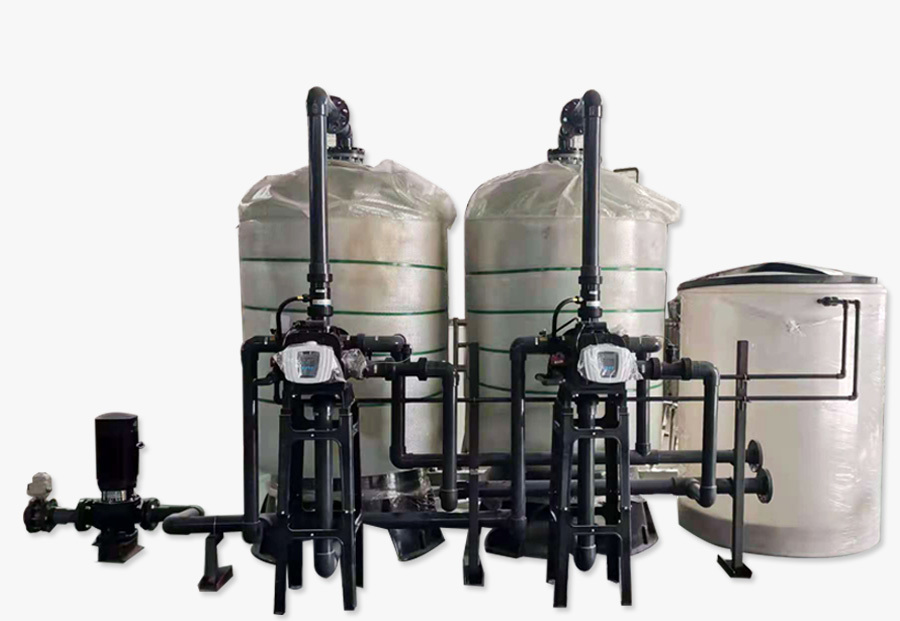
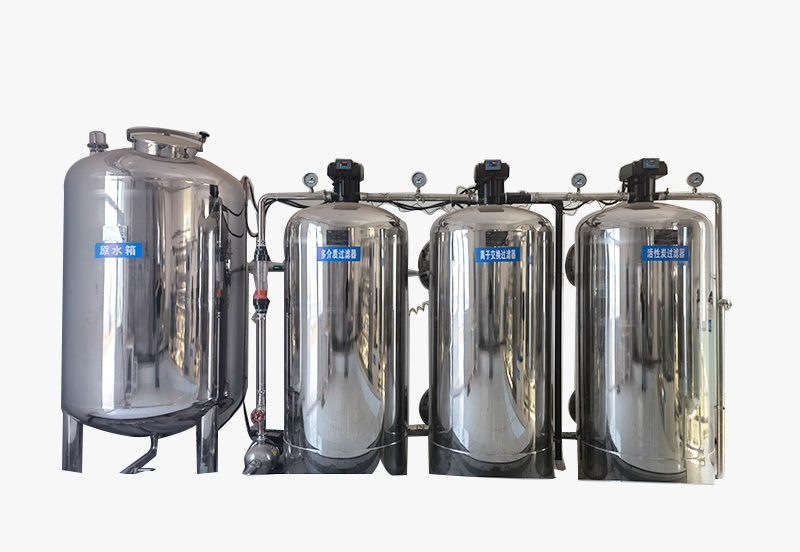
Water softening equipment, as the name suggests, is equipment that reduces water hardness. It mainly removes calcium and magnesium ions from water, which simply means equipment that reduces water hardness. Its main functions include removing calcium and magnesium ions from water, activating water quality, sterilizing and algaeciding, and preventing and removing scale. During the softening process, water softening equipment cannot reduce the total salt content in the water. It is widely used in hot water boiler systems, heat exchange systems, industrial cooling systems, central air conditioning systems, and other water-using equipment systems.
Working principle
Since the hardness of water is mainly formed and represented by calcium and magnesium, cation exchange resin (water softener) is generally used to replace Ca2+ and Mg2+ (the main components of scale) in the water. As the increase of Ca2+ and Mg2+ in the resin, the efficiency of the resin removing Ca2+ and Mg2+ gradually decreases.
After the resin absorbs calcium and magnesium ions, it must be regenerated. The regeneration process is to rinse the resin layer with brine from the salt tank to replace the hardness ions on the resin and discharge them out of the tank with the regeneration waste liquid, and the resin will restore its softening exchange function.
Since the hardness of water is mainly formed and represented by calcium and magnesium, the principle of sodium ion exchange softening treatment is to pass the raw water through a sodium-type cation exchange resin, so that the hardness components Ca2+ and Mg2+ in the water are exchanged with Na+ in the resin, thereby adsorbing Ca2+ and Mg2+ in the water to soften the water.
Tags:
-- Recommended --


Shijiazhuang Tianwang Environmental Protection Technology Co., Ltd.
Shijiazhuang Tianwang Environmental Protection Technology Co., Ltd. is a high-tech enterprise specializing in the research and development, manufacturing and sales of water treatment equipment.
Contact Information
Production address: No. 9, Fengchan Road, Economic and Technological Development Zone, Shijiazhuang City
Office Address: 25th Floor, Block C, No. 310 Changjiang Avenue, Shijiazhuang High-tech Development Zone
Contact Number:
0311-89272359 0311-68039237
Enterprise Email:
twhbkj@163.com
Website: en.sjztwhb.com